11
Keyword matching asks if a resume contains the right words. Reasoning-based AI asks if the career tells a coherent story. Here's why the difference is everything.
Advanced
Watched by 456 people
How AI Reads a Resume — And How You Should?
Two resumes arrive for a Senior Product Manager role at a Series C fintech. The JD asks for 6+ years of PM experience, B2B SaaS, experience shipping payments or financial products, and a track record of working with engineering in agile teams.
Resume A: Senior Product Manager at a mid-sized SaaS company. Six years of PM experience, exactly. Lists every keyword in the JD — payments, B2B, agile, engineering partnership, roadmap, cross-functional. Previous roles at two other SaaS companies. Computer Science degree. Resume is clean, tight, optimized.
Resume B: Three years as a founder of a B2C fintech that shut down. Two years as a founding PM at a seed-stage payments startup (since acquired). One year leading product at a small B2B analytics company. No keyword match to "agile" or "cross-functional." No mention of "roadmap" by that name. Computer Engineering degree from a school you haven't heard of.
A keyword-matching ATS picks Resume A. It matches more terms. It has the cleaner title progression. It looks like the job description, if the job description were a person.
A reasoning-based model picks Resume B. Not because B has the keywords — it doesn't. Because B has shipped real payments products from zero to one, has the specific scar tissue of a failed venture and the specific success of an acquired one, and shows a trajectory that suggests the person will thrive in the ambiguity a Series C role actually contains. The keywords were never the job. They were a proxy for the job. B has the job.
This is the difference between matching and reasoning. Everything else in AI hiring is downstream of it.
What Keyword Matching Actually Does?
Keyword matching, at its core, is string comparison. The ATS takes the job description, extracts the terms you care about, and looks for those terms in each incoming resume. More terms matched, higher rank. Fewer terms matched, lower rank. This is implemented more or less the same way in every major ATS.
This worked when resumes were written by hand and candidates with the right background naturally included the right terms. A Senior Product Manager with B2B SaaS experience would naturally write "roadmap," "cross-functional," "agile" — those are the words that describe her actual work. The keyword match was a reasonable filter for attention and effort.
Today those conditions don't hold. A candidate using AI can inject every keyword from the JD into a resume in under two minutes, whether or not those keywords represent what they've actually done. So the filter isn't measuring fit anymore. It's measuring whether the candidate cared to game it.
Worse, keyword matching systematically penalizes the candidates you most want. Someone with a non-traditional path — a founder who pivoted to a PM role, an engineer who moved into product, a candidate from an adjacent industry — is unlikely to have the exact keyword stack the JD expects. Their career produced the capabilities without producing the vocabulary. The ATS can't tell the difference and rejects them.
This isn't a minor edge case. For hard-to-fill roles, the candidates ruled out by keyword matching are often the best-fit candidates available.
What Reasoning Does Differently?
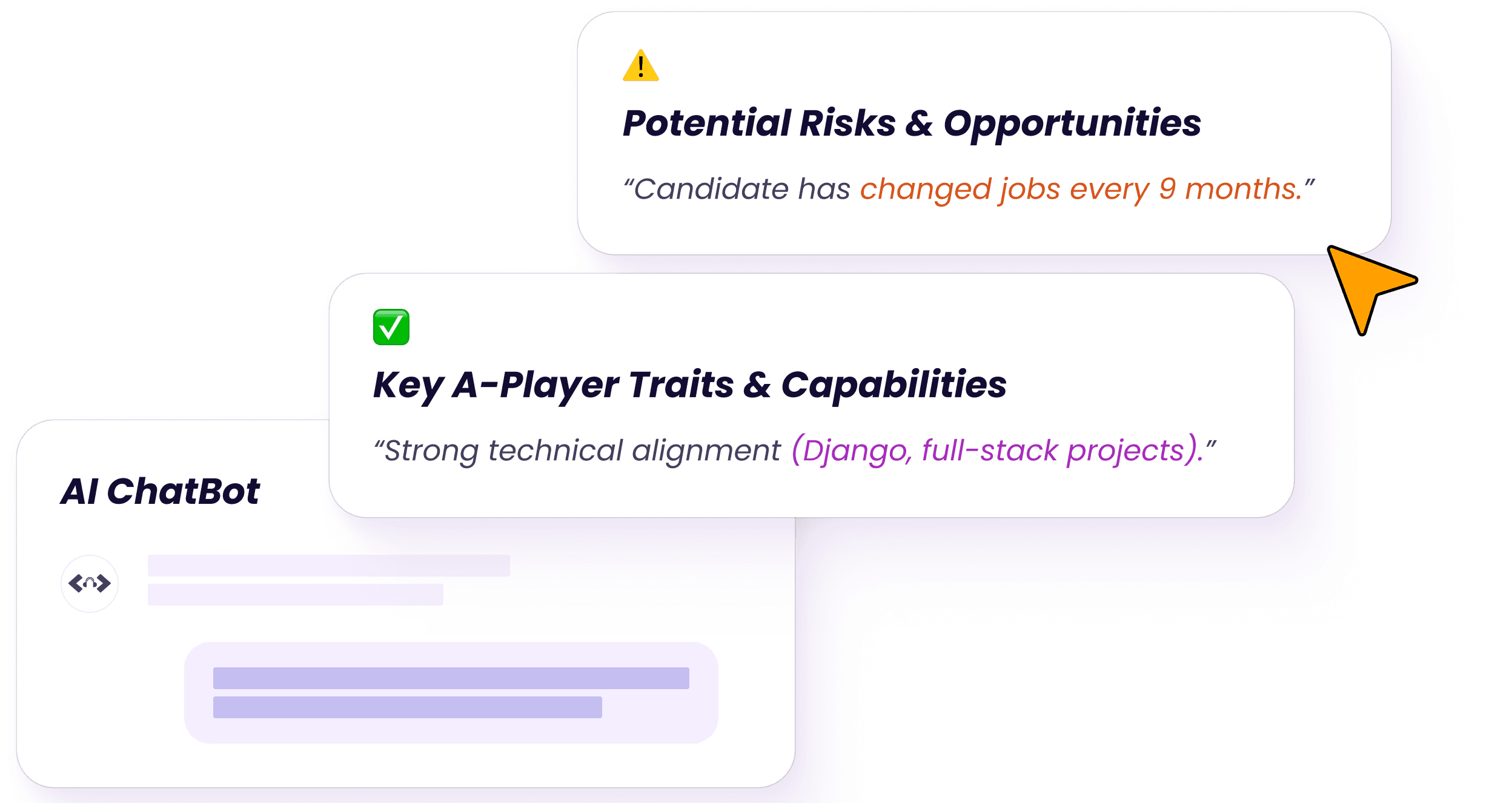
Reasoning-based AI — the kind underlying modern hiring tools — reads a resume the way a good recruiter would, if a good recruiter had time to read every resume carefully.
Instead of asking "does this resume contain the words from the JD?", it asks a sequence of harder questions:
- What did this person actually do?
- What does that work prepare them for?
- Does the trajectory across roles tell a coherent story?
- How do their specific experiences map to the specific demands of this role?
- What's the plausible shape of their next move, and is it this one?
A reasoning model can read "Founding PM at a seed-stage payments startup, since acquired" and understand what that meant in practice — that the person likely owned product strategy without a manager to escalate to, built customer discovery from scratch, wrote the first PRDs anyone at the company had seen, coordinated engineering across a small team with no formal process, and lived through whatever crisis or success led to the acquisition. None of those words are in the resume. A reasoning model knows they're implied by the role.
The same model can read "Product Manager at a mid-sized SaaS company" and understand that the person likely inherited a roadmap, operated within an established product org, and had less latitude than the founding PM despite sharing a title. Again, nothing in the resume explicitly says this. The model reasons from what the role typically contains at that company stage.
Now apply that reasoning at scale across 250 resumes. Every candidate gets read for what their career actually demonstrates, not for whether they happened to include the right vocabulary. The shortlist that comes out the other side looks different from what the keyword match would produce — and consistently, it performs better.
What Reasoning Surfaces That Matching Misses?
Three kinds of candidates become visible when you stop matching and start reasoning.
The adjacent-skill candidate. Someone whose title or industry doesn't match but whose capabilities do. A backend engineer at a data-heavy startup who's been doing data engineering work for three years but whose title doesn't say "Data Engineer." An ops lead at a marketplace who's been doing product work without the title. These candidates usually rank at the bottom of keyword searches. Reasoning pulls them up.
The non-linear career. Someone whose path includes a sabbatical, a failed venture, a career pivot, or a step back that set up a step forward. Keyword matching treats the gaps as noise. Reasoning reads them as context — a candidate who left a senior role to found something, returned to an IC role after the founding experience, and is now moving back into leadership has a specific and often very desirable profile. The keyword match sees a zigzag. Reasoning sees a story.
The candidate with transferable depth. Someone with unusual depth in an adjacent domain — say, a Senior Analyst from a top consulting firm applying for a Product role. They don't have product titles. They have structured problem-solving, stakeholder management, cross-functional project experience, and three years of pattern recognition across a dozen industries. That's a strong PM candidate. Keyword matching doesn't see it. Reasoning does.
Each of these is what AgentR calls "non-standard talent" — qualified candidates that traditional ATS filtering systematically misses. In most pipelines, they're the candidates most likely to outperform. They're also the candidates most likely to be rejected by your current tooling.
How You Should Read a Resume?
The shift in how AI reads resumes should change how you read them too.
Stop scanning for keywords. You already have tools that do that, and they were never the signal you actually wanted. Start reading for story. The questions that matter:
What does this person's career trajectory suggest about their capability now?
What did they actually do in each role, as opposed to what the title implies?
Does each move make sense in light of the previous ones?
What's the most likely reason they're applying for this role, and does that reason align with what the role actually is?
These are questions a recruiter asks on instinct for the top 10 candidates they carefully review. What's changed is that you can now ask them — systematically and consistently — for every candidate, because an AI agent is doing the first pass.
That's the real shift. Not that AI is "better than humans" at reading resumes. It isn't, in any given case. It's that AI lets you apply the standards of thoughtful human review across the full volume of applications, instead of applying rigorous review to ten and triage to the other 240.
The Old Screening Job is Over
The old job of screening was sorting. Take the pile, apply filters, shrink it to a shortlist, hand the shortlist to humans for real evaluation. That job was always a compromise. It was always going to miss candidates whose profiles didn't conform. It was especially going to miss the non-standard talent that often represents the best hires.
The new job of screening is understanding. Read every resume against what the role actually needs. Surface the candidates whose careers suggest fit, regardless of whether their vocabulary matches. Explain the reasoning so a human can agree or disagree. Let the recruiter's attention go to judgment instead of triage.
Companies that have switched to reasoning-based screening report a 2.7x improvement in performance rankings of hires. That's not because the tool is picking different people from the same pool. It's because the tool is surfacing people who were in the pool all along — the pool your previous filter couldn't see.
Match is over. Reasoning is the job now.
Next: Lesson 12 — Career Pattern Analysis

2026 AgentR, All rights reserved