12
Career pattern analysis reads the shape of a career, not just the words on the resume. Here are the 5 patterns that reveal A Players keyword search can't find.
Advanced
Watched by 587 people
Career pattern analysis is a method of reading a resume for the shape of a person's career — trajectory, intentionality, adaptability, industry fit, and context fit — rather than for keyword overlap with a job description. It surfaces qualified candidates whose backgrounds don't match the surface-level requirements of a role but whose careers suggest they'll perform well in it. Traditional keyword-based ATS systems systematically miss these candidates. Reasoning-based AI makes pattern analysis possible at the scale of modern application volume.
This lesson walks through the five core patterns, explains what each reveals, and shows why pattern analysis consistently outperforms keyword matching on quality of hire.
Why Keyword Search Misses Great Candidates?
The Applicant Tracking System asks one question of every resume: "Does this document contain the terms I care about?" That question was reasonable in 2001 when applications were scarce and candidates wrote resumes by hand. It is an increasingly poor proxy for fit in 2026, for two reasons.
First, AI has made it trivial for any candidate to inject the exact keyword set from any job description. The signal the keyword match was designed to capture — candidate effort and relevant background — has been automated away. What's left is noise.
Second, keyword matching systematically rejects a specific kind of candidate: the one whose capabilities were built under a different job title, in a different industry, or along a non-linear path. These candidates rarely have the vocabulary the JD expects. They have the capability, just under different names. Keyword search can't see them.
A different reading method is required. The five patterns below are what a thoughtful senior recruiter would look at if they had time to read every resume carefully — the shape of the career, not the words.
The Five Career Patterns
Pattern analysis isn't pseudoscience. Each pattern is grounded in something any good recruiter already half-recognizes — they just don't usually have the time to apply it across 250 applications.
Pattern 1: Trajectory
Trajectory is the 'shape' of a career progression over time. It answers: what direction has this person been moving, at what pace, with what consistency?
Strong trajectories don't all look the same. A steep rise — junior to senior in five years — signals high performance, but so does a slower, deeper progression with expanding scope and responsibility at each step. A lateral move can signal either stagnation or a deliberate pivot into a more valuable lane. A step down can signal burnout, or it can signal a person buying themselves space to do more ambitious work.
What matters is whether the trajectory is coherent. Does each role make sense given what came before and what came after? A resume showing a thoughtful progression — even an unconventional one — reads very differently from a resume showing random motion. Keyword search treats both the same. Pattern analysis distinguishes them.
Pattern 2: Intentionality
Intentionality is the story behind the trajectory. Do this person's moves suggest deliberate choices or reactive drift?
Intentional careers tend to show up as a sequence of moves that each build on the last in a direction the person seems to have chosen. Someone who started in customer support, moved into product operations, then into product management, then into a product leadership role is telling a coherent story about building toward something specific. The titles don't match a product leader JD at the early stages. The story clearly does.
Reactive careers show up as a sequence of moves that seem to happen to the person rather than by them — a layoff, a company closure, a pivot into the first available role, another layoff. Sometimes this is just bad luck, and a good recruiter reads context into it. Other times it signals a person who hasn't been in the driver's seat of their career. Pattern analysis makes the distinction legible.
Pattern 3: Adaptability
Adaptability is how well a person performs across different contexts — different company stages, different team sizes, different industries, different working styles.
A candidate who has succeeded at a 10,000-person enterprise, a 200-person growth-stage company, and a 20-person startup is demonstrating something a candidate with equivalent seniority at one company cannot demonstrate: that their capabilities transfer. That matters enormously for any role where the context will change, which is most roles in modern companies.
Low-adaptability signals aren't disqualifying. Some of the best hires are people who've been at one company for 12 years and know a domain deeply. But for a role that will require operating across contexts, a candidate's adaptability pattern tells you something keyword search cannot.
Pattern 4: Industry fit
Industry fit asks whether a candidate's trajectory is moving toward your sector or away from it.
A product manager with 8 years of B2B SaaS experience applying to a B2C consumer role is a candidate moving toward a new domain. That can be a strength — fresh perspective — or a risk — steep learning curve on the fundamentals. What distinguishes the two is how deliberate the move appears and what adjacent experience supports it.
Conversely, a candidate whose last three moves have been deeper into your exact sector is sending a clear signal: this is the industry they've chosen to build in. That kind of commitment correlates strongly with retention, which matters more than most hiring decisions account for.
Both kinds of candidates can be strong. What matters is reading the direction of the fit, not just the current match.
Pattern 5: Context fit
Context fit captures the fine-grained signals about what kind of environment a candidate has thrived in — and by implication, will likely thrive in again.
This pattern includes things like: have they worked remotely, hybrid, or exclusively in-office? Have they been at founder-led companies or professionalized organizations? Have they operated under tight process or ambiguity? Have they been in fast-scaling environments or steady-state ones?
A candidate whose last 10 years have been at highly-structured enterprise companies may struggle in a 30-person startup — not because they lack capability, but because the environment will feel alien. The reverse is also true: a career startup operator often chafes in a corporate role with long decision cycles. Pattern analysis surfaces these fits and mismatches before the interview, when they're cheap to discuss.
What Pattern Analysis Surfaces That Keywords Miss?
Three kinds of candidates become visible the moment you switch from matching to pattern analysis.
The career pivoter. Someone whose titles across their last three roles don't match your JD, but whose trajectory is clearly moving toward the work you're hiring for. The most common version: operators who've moved through several adjacent functions and are now ready for a leadership role that synthesizes them. Keyword search rejects them. Pattern analysis flags them.
The high-adaptability generalist. Someone whose career shows success across unusually varied contexts. These candidates are often undervalued because they don't have the deep specialization of someone who's done one thing for a decade. But for roles that require operating across contexts — which is most senior roles — they're often the strongest hire. Keyword search can't see adaptability. Pattern analysis makes it visible.
The intentional outsider. Someone coming into your industry from an adjacent one, but doing so deliberately, with capabilities that clearly transfer. Keyword search rejects them as not-industry. Pattern analysis sees the direction of motion and the relevance of the underlying skills.
These three profiles are what AgentR calls "non-standard talent" — candidates whose resumes don't fit the pattern your ATS was trained to recognize, but whose careers suggest they'll outperform the candidates it does recognize. In most pipelines, non-standard talent is where your best hires are hiding.
How AI Makes Pattern Analysis Scalable?
A thoughtful human can read any one resume and identify these patterns. That's not new. What's new is being able to do it consistently across 250 applications.
A human reviewer reading carefully can manage maybe 15 resumes in depth before fatigue sets in. By resume 50, the patterns start to blur. By resume 150, every candidate looks the same. Pattern analysis only works if it's applied consistently across the whole batch — and at modern application volumes, no human can do that alone.
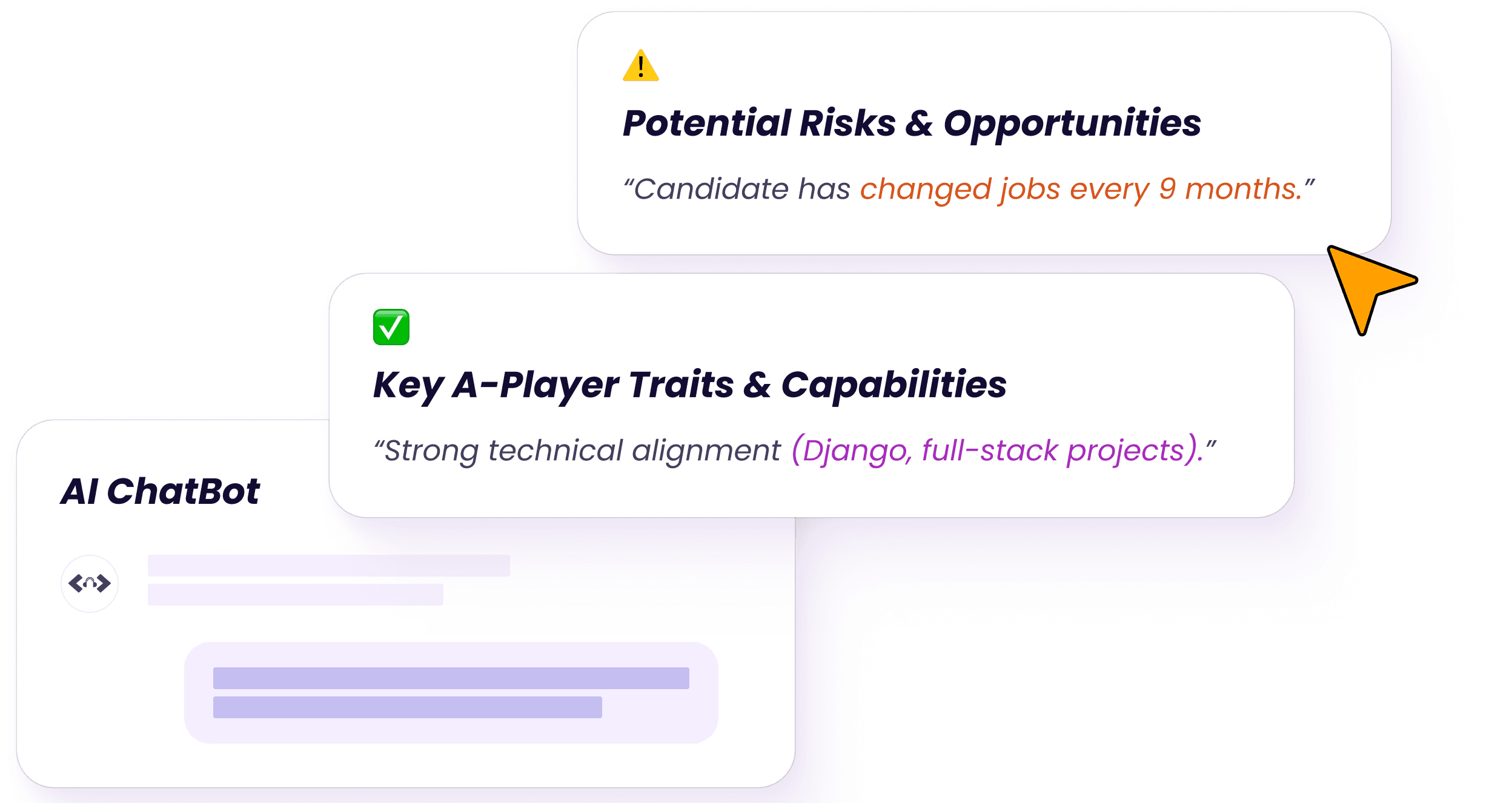
Reasoning-based AI can. It reads each resume with fresh attention, identifies the patterns, and produces a ranked shortlist with an explicit rationale for each ranking. The output isn't a score. It's an argument: "this candidate ranks highly despite the mismatched title because their trajectory over the last six years shows deliberate movement toward this exact kind of role, with high adaptability across company stages." A recruiter can read that argument, agree or disagree, and make their own call.
That's the point. Pattern analysis at scale doesn't replace human judgment. It makes human judgment applicable to every candidate instead of just the top 20 that survived the keyword filter.
AgentR's platform analyzes 30+ career patterns across every incoming application — an expansion on the five core patterns above, applied consistently regardless of volume. Companies using this approach report 2.7x better performance rankings on hires six and twelve months in. Not because the tool picks different people from the same pool. Because it surfaces people who were in the pool all along — the non-standard talent the previous filter couldn't see.
The Shift in What Screening Means
The old job of screening was triage. Shrink 250 to 25. The new job of screening is understanding. Read every candidate's career for what it actually demonstrates, surface the pattern, and hand the decision to a human who can now spend their attention on judgment instead of sorting.
Career pattern analysis is the specific method that makes this shift possible. It's not a feature. It's a different way of reading a resume — one that matches how senior recruiters have always wanted to read resumes, but couldn't, at the scale the job demands.
The careers are where the signal has always been. We just finally have a way to read them all.
Next: Lesson 13 — Building Screening Questions That Reveal Potential

2026 AgentR, All rights reserved