30 Career Patterns That Predict Success Better Than Any Keyword Match
30 Career Patterns That Predict Success Better Than Any Keyword Match
30 Career Patterns That Predict Success Better Than Any Keyword Match
The resume tells you what someone has done. The trajectory tells you who they are.
The resume tells you what someone has done. The trajectory tells you who they are.
The resume tells you what someone has done. The trajectory tells you who they are.

5 min read
5 min read
5 min read
Get weekly updates
Get weekly updates
Explainers
Explainers
Explainers
Published on:
Published on:
Published on:
Read Time:
Read Time:
Read Time:
Category:
Category:
Category:
A resume is a curated document. It’s edited, ordered, and framed to present the most compelling version of a career. Every word is chosen. Every experience is positioned. It is, by design, a performance.
A career trajectory is a sequence of facts. Where someone worked. For how long. What they moved toward and what they moved away from. What the progression looked like relative to their peers. How they behaved when things went wrong.
You cannot easily curate a trajectory. You can polish the presentation, but you can’t change the sequence. The facts of what someone did, in what order, are either there or they’re not.
This is why career pattern analysis, evaluating the arc of a career rather than the content of a document, is structurally more predictive than keyword matching, and structurally harder to game.
What follows is a practical taxonomy of the patterns that actually matter.
Category 1: Progression Signals
These patterns tell you whether someone’s career is moving forward, why, and at what rate.
1. Progression velocity. How fast is this person advancing relative to the norms of their sector and function? A recruiter who makes VP in 8 years at a competitive firm is telling you something different from one who makes VP in 8 years at a company that promotes by tenure. Context is everything. Velocity without context is noise.
2. Scope expansion over time. Titles are unreliable. Scope isn’t. Look for whether the responsibilities are genuinely growing, more people, more budget, more consequence per decision, or whether the titles are changing while the actual work stays flat. Lateral moves that broaden scope are often more predictive than vertical moves that don’t.
3. Promotion from within vs. external moves. Internal promotions are a signal that someone’s immediate peers, who know them best, valued them enough to advocate for their advancement. External moves are a signal of ambition and market value. The combination of both, in the right sequence, is one of the cleaner indicators of genuine high performance.
4. Tenure relative to outcome. Two years at a company that was growing fast and where the person demonstrably contributed to that growth is different from two years at a company where they managed a static function. Short tenure without obvious cause can be a signal; short tenure with a clear exit story, startup ran out of runway, company acquired, role achieved its purpose, usually isn’t.
5. Upward moves vs. lateral moves vs. regressions. Not every career moves in a straight line, and not every lateral or downward move is a negative signal. But the pattern of what types of moves someone makes, and why, is revealing. A deliberate step sideways to gain a specific capability is a positive signal. A step backward with no clear strategic logic is worth probing.
Category 2: Achievement Patterns
These patterns reveal how someone performs under different conditions, and whether their impact is real.
6. Specificity of outcome claims. High performers can tell you exactly what happened. The numbers are specific. The timeline is specific. The counterfactual is clear: they can describe what would have happened without them. Weak candidates describe activities, not outcomes: “managed the project,” “worked with the team,” “contributed to the initiative.” The absence of outcome specificity is a strong signal on its own.
7. Performance in resource-constrained environments. Anyone can look good with a big budget, a strong team, and leadership support. The predictive version of performance is what someone delivered when the resources weren’t there, the underfunded team, the chaotic startup, the project nobody wanted to run. These situations reveal judgment, resourcefulness, and the ability to prioritise under pressure.
8. Recovery from failure. Almost every meaningful career contains a failure. The pattern to look for is not absence of failure, it’s whether someone has engaged honestly with a setback, drawn conclusions from it, and demonstrably changed their approach. The candidate who describes every challenge as something they navigated smoothly to a successful outcome has either been very lucky or is not being honest.
9. Consistency across contexts. Did the candidate perform well in multiple environments, or did they perform well once? A track record of consistent impact across different companies, different team sizes, different market conditions is far more predictive than a single strong performance that might be attributable to circumstance.
10. First-90-days impact. When someone joins a new organisation, how quickly do they produce impact? The pattern of how candidates describe their early periods in roles, specifically what they changed, built, or fixed in their first quarter, reveals a great deal about how they approach unfamiliar environments.
Category 3: Adaptability Indicators
These patterns distinguish candidates who perform in stable environments from those who perform when things change.
11. Sector and function transitions. Successful moves across industries or functions are strong adaptability signals. They suggest the candidate can transfer capabilities across contexts, which is exactly what’s required when a company changes strategy, acquires a business, or pivots its market position.
12. Company stage diversity. Someone who has worked in both early-stage and mature organisations understands that the same title requires completely different behaviours in different contexts. Stage diversity is one of the most undervalued signals in hiring.
13. Response to structural change. How did the candidate respond to the restructure, the leadership change, the strategy pivot, the acquisition? Did they adapt and continue to perform? Did they leave? Did they stay and stagnate? The pattern of behaviour through organisational disruption is highly predictive of behaviour through your own future disruptions.
14. Upskilling trajectory. Is there evidence that the candidate actively develops their capabilities, new tools adopted, adjacent skills built, formal learning undertaken, or does their skill set look static relative to the pace of change in their field? In fast-moving sectors, the candidate who isn’t actively developing is falling behind even while their title advances.
15. Comfort with ambiguity markers. Roles that are poorly defined, companies that are figuring themselves out, projects that didn’t have a clear brief, these are common in growing organisations. Candidates who have consistently chosen, performed in, and created structure from ambiguous situations are telling you something important.
Category 4: Intentionality Signals
These patterns distinguish people who have agency over their career from those who are being carried by circumstances.
16. Coherence of career intent. When you look at the full sequence of moves, is there a through-line? Not a linear path, careers don’t work that way, but a coherent story about what the person was trying to build, learn, or achieve. The candidate who can tell you why each move made sense, in retrospect and at the time, is showing you intentional agency. The one who describes their career as a series of things that happened to them is showing you something different.
17. Values-driven exits. Why did someone leave? The answer reveals a great deal about what they actually care about. “Better opportunity” tells you little. “I’d achieved what I went there to do” tells you they’re outcome-oriented. “The organisation was moving away from the work I found meaningful” tells you they have a clear internal compass. “The culture shifted in a direction I couldn’t get behind” tells you they have convictions.
18. Self-selection into challenge. Did the candidate take the hard posting, the difficult project, the role that needed rescuing, the assignment nobody else wanted? A pattern of choosing challenge over comfort is a strong predictor of high performance, and of the kind of intrinsic motivation that sustains performance over time.
19. Investment in people around them. For any candidate who has managed others, the track record of the people they managed is the most predictive signal available. Did people on their teams get promoted? Go on to strong subsequent roles? Build careers that they speak positively about? The quality of a manager’s output is its people.
20. Long-term relationship with mentors and sponsors. Professional relationships that span years are a strong signal of character. People who have maintained meaningful professional relationships over a long period of time are telling you something about their reliability, their trustworthiness, and their ability to invest in relationships that don’t have immediate transactional value.
Category 5: Problem-solving and Judgment Signals
These patterns are best revealed through structured interview follow-up, but the career record surfaces them first.
21. Complexity of problems solved. Not just “managed a team” but what kind of problems did that team face, how intractable were they, what was the scope of the consequences? The complexity and novelty of the challenges someone has navigated is a direct measure of the judgment they’ve been required to exercise.
22. Decision-making under incomplete information. Did the candidate routinely make decisions with full information and clear authority, or did they frequently operate in situations where they had to act before the data was complete? The latter is harder, more common in high-growth environments, and more predictive of performance in similar future contexts.
23. Stakeholder management complexity. How many competing interests has this person had to navigate? The candidate who has managed upward, sideways, and downward simultaneously, with different stakeholders pulling in different directions, has exercised a category of judgment that pure technical performers often haven’t.
24. First principles reasoning. When a candidate describes how they solved a problem, are they describing a methodology they applied or are they describing actual reasoning? The difference is revealing. Methodology application is learned. First principles reasoning is a capability.
25. Learning from other people’s mistakes. Does the candidate’s account of their development include things they learned from observing others, mistakes they saw colleagues make, approaches they saw fail elsewhere, decisions they made differently because of what they’d witnessed? This kind of vicarious learning is a marker of genuine intellectual engagement with work.
Category 6: Culture and Character Signals
26. Candour about limitations. A candidate who can describe, with specificity and without defensiveness, the things they’re not good at, the types of work they find draining, the environments where they don’t perform well, this is a high-trust signal. It requires self-awareness, security, and intellectual honesty. These are rare and valuable.
27. Consistency between public and private narrative. What a candidate says to their references versus what they say in interview should be consistent. Significant divergences are worth probing. Most people don’t lie outright; they emphasise different things for different audiences. The degree of divergence is a signal.
28. How they talk about former colleagues. The candidate who speaks carefully and specifically about former colleagues, acknowledging where they disagreed but framing it without contempt, is showing you something about their character. The candidate who describes everyone they’ve worked with as either brilliant or incompetent is showing you something else.
29. Curiosity outside their domain. High performers in complex roles tend to be intellectually curious across a wider range than their job description. What they read, what problems they find interesting outside of work, what they’re trying to figure out, these are low-stakes but revealing signals about cognitive engagement.
30. What they want the next chapter to look like. Not “where do you see yourself in five years,” that question has a standard answer. But a genuine exploration of what they’re trying to build, what they want to learn, what problems they want to be working on, reveals whether the role you’re hiring for is genuinely aligned with their trajectory or a waypoint they’re willing to describe strategically.
None of these patterns is sufficient on its own. A career trajectory read well requires weighting signals in context, understanding the norms of the industry and period in question, and bringing genuine judgment to ambiguous cases.
What it doesn’t require is a keyword match. The word “leadership” appearing on a resume tells you almost nothing about any of these thirty dimensions. The trajectory tells you quite a lot.
The resume got you in the door. The career is what you’re actually hiring.
A resume is a curated document. It’s edited, ordered, and framed to present the most compelling version of a career. Every word is chosen. Every experience is positioned. It is, by design, a performance.
A career trajectory is a sequence of facts. Where someone worked. For how long. What they moved toward and what they moved away from. What the progression looked like relative to their peers. How they behaved when things went wrong.
You cannot easily curate a trajectory. You can polish the presentation, but you can’t change the sequence. The facts of what someone did, in what order, are either there or they’re not.
This is why career pattern analysis, evaluating the arc of a career rather than the content of a document, is structurally more predictive than keyword matching, and structurally harder to game.
What follows is a practical taxonomy of the patterns that actually matter.
Category 1: Progression Signals
These patterns tell you whether someone’s career is moving forward, why, and at what rate.
1. Progression velocity. How fast is this person advancing relative to the norms of their sector and function? A recruiter who makes VP in 8 years at a competitive firm is telling you something different from one who makes VP in 8 years at a company that promotes by tenure. Context is everything. Velocity without context is noise.
2. Scope expansion over time. Titles are unreliable. Scope isn’t. Look for whether the responsibilities are genuinely growing, more people, more budget, more consequence per decision, or whether the titles are changing while the actual work stays flat. Lateral moves that broaden scope are often more predictive than vertical moves that don’t.
3. Promotion from within vs. external moves. Internal promotions are a signal that someone’s immediate peers, who know them best, valued them enough to advocate for their advancement. External moves are a signal of ambition and market value. The combination of both, in the right sequence, is one of the cleaner indicators of genuine high performance.
4. Tenure relative to outcome. Two years at a company that was growing fast and where the person demonstrably contributed to that growth is different from two years at a company where they managed a static function. Short tenure without obvious cause can be a signal; short tenure with a clear exit story, startup ran out of runway, company acquired, role achieved its purpose, usually isn’t.
5. Upward moves vs. lateral moves vs. regressions. Not every career moves in a straight line, and not every lateral or downward move is a negative signal. But the pattern of what types of moves someone makes, and why, is revealing. A deliberate step sideways to gain a specific capability is a positive signal. A step backward with no clear strategic logic is worth probing.
Category 2: Achievement Patterns
These patterns reveal how someone performs under different conditions, and whether their impact is real.
6. Specificity of outcome claims. High performers can tell you exactly what happened. The numbers are specific. The timeline is specific. The counterfactual is clear: they can describe what would have happened without them. Weak candidates describe activities, not outcomes: “managed the project,” “worked with the team,” “contributed to the initiative.” The absence of outcome specificity is a strong signal on its own.
7. Performance in resource-constrained environments. Anyone can look good with a big budget, a strong team, and leadership support. The predictive version of performance is what someone delivered when the resources weren’t there, the underfunded team, the chaotic startup, the project nobody wanted to run. These situations reveal judgment, resourcefulness, and the ability to prioritise under pressure.
8. Recovery from failure. Almost every meaningful career contains a failure. The pattern to look for is not absence of failure, it’s whether someone has engaged honestly with a setback, drawn conclusions from it, and demonstrably changed their approach. The candidate who describes every challenge as something they navigated smoothly to a successful outcome has either been very lucky or is not being honest.
9. Consistency across contexts. Did the candidate perform well in multiple environments, or did they perform well once? A track record of consistent impact across different companies, different team sizes, different market conditions is far more predictive than a single strong performance that might be attributable to circumstance.
10. First-90-days impact. When someone joins a new organisation, how quickly do they produce impact? The pattern of how candidates describe their early periods in roles, specifically what they changed, built, or fixed in their first quarter, reveals a great deal about how they approach unfamiliar environments.
Category 3: Adaptability Indicators
These patterns distinguish candidates who perform in stable environments from those who perform when things change.
11. Sector and function transitions. Successful moves across industries or functions are strong adaptability signals. They suggest the candidate can transfer capabilities across contexts, which is exactly what’s required when a company changes strategy, acquires a business, or pivots its market position.
12. Company stage diversity. Someone who has worked in both early-stage and mature organisations understands that the same title requires completely different behaviours in different contexts. Stage diversity is one of the most undervalued signals in hiring.
13. Response to structural change. How did the candidate respond to the restructure, the leadership change, the strategy pivot, the acquisition? Did they adapt and continue to perform? Did they leave? Did they stay and stagnate? The pattern of behaviour through organisational disruption is highly predictive of behaviour through your own future disruptions.
14. Upskilling trajectory. Is there evidence that the candidate actively develops their capabilities, new tools adopted, adjacent skills built, formal learning undertaken, or does their skill set look static relative to the pace of change in their field? In fast-moving sectors, the candidate who isn’t actively developing is falling behind even while their title advances.
15. Comfort with ambiguity markers. Roles that are poorly defined, companies that are figuring themselves out, projects that didn’t have a clear brief, these are common in growing organisations. Candidates who have consistently chosen, performed in, and created structure from ambiguous situations are telling you something important.
Category 4: Intentionality Signals
These patterns distinguish people who have agency over their career from those who are being carried by circumstances.
16. Coherence of career intent. When you look at the full sequence of moves, is there a through-line? Not a linear path, careers don’t work that way, but a coherent story about what the person was trying to build, learn, or achieve. The candidate who can tell you why each move made sense, in retrospect and at the time, is showing you intentional agency. The one who describes their career as a series of things that happened to them is showing you something different.
17. Values-driven exits. Why did someone leave? The answer reveals a great deal about what they actually care about. “Better opportunity” tells you little. “I’d achieved what I went there to do” tells you they’re outcome-oriented. “The organisation was moving away from the work I found meaningful” tells you they have a clear internal compass. “The culture shifted in a direction I couldn’t get behind” tells you they have convictions.
18. Self-selection into challenge. Did the candidate take the hard posting, the difficult project, the role that needed rescuing, the assignment nobody else wanted? A pattern of choosing challenge over comfort is a strong predictor of high performance, and of the kind of intrinsic motivation that sustains performance over time.
19. Investment in people around them. For any candidate who has managed others, the track record of the people they managed is the most predictive signal available. Did people on their teams get promoted? Go on to strong subsequent roles? Build careers that they speak positively about? The quality of a manager’s output is its people.
20. Long-term relationship with mentors and sponsors. Professional relationships that span years are a strong signal of character. People who have maintained meaningful professional relationships over a long period of time are telling you something about their reliability, their trustworthiness, and their ability to invest in relationships that don’t have immediate transactional value.
Category 5: Problem-solving and Judgment Signals
These patterns are best revealed through structured interview follow-up, but the career record surfaces them first.
21. Complexity of problems solved. Not just “managed a team” but what kind of problems did that team face, how intractable were they, what was the scope of the consequences? The complexity and novelty of the challenges someone has navigated is a direct measure of the judgment they’ve been required to exercise.
22. Decision-making under incomplete information. Did the candidate routinely make decisions with full information and clear authority, or did they frequently operate in situations where they had to act before the data was complete? The latter is harder, more common in high-growth environments, and more predictive of performance in similar future contexts.
23. Stakeholder management complexity. How many competing interests has this person had to navigate? The candidate who has managed upward, sideways, and downward simultaneously, with different stakeholders pulling in different directions, has exercised a category of judgment that pure technical performers often haven’t.
24. First principles reasoning. When a candidate describes how they solved a problem, are they describing a methodology they applied or are they describing actual reasoning? The difference is revealing. Methodology application is learned. First principles reasoning is a capability.
25. Learning from other people’s mistakes. Does the candidate’s account of their development include things they learned from observing others, mistakes they saw colleagues make, approaches they saw fail elsewhere, decisions they made differently because of what they’d witnessed? This kind of vicarious learning is a marker of genuine intellectual engagement with work.
Category 6: Culture and Character Signals
26. Candour about limitations. A candidate who can describe, with specificity and without defensiveness, the things they’re not good at, the types of work they find draining, the environments where they don’t perform well, this is a high-trust signal. It requires self-awareness, security, and intellectual honesty. These are rare and valuable.
27. Consistency between public and private narrative. What a candidate says to their references versus what they say in interview should be consistent. Significant divergences are worth probing. Most people don’t lie outright; they emphasise different things for different audiences. The degree of divergence is a signal.
28. How they talk about former colleagues. The candidate who speaks carefully and specifically about former colleagues, acknowledging where they disagreed but framing it without contempt, is showing you something about their character. The candidate who describes everyone they’ve worked with as either brilliant or incompetent is showing you something else.
29. Curiosity outside their domain. High performers in complex roles tend to be intellectually curious across a wider range than their job description. What they read, what problems they find interesting outside of work, what they’re trying to figure out, these are low-stakes but revealing signals about cognitive engagement.
30. What they want the next chapter to look like. Not “where do you see yourself in five years,” that question has a standard answer. But a genuine exploration of what they’re trying to build, what they want to learn, what problems they want to be working on, reveals whether the role you’re hiring for is genuinely aligned with their trajectory or a waypoint they’re willing to describe strategically.
None of these patterns is sufficient on its own. A career trajectory read well requires weighting signals in context, understanding the norms of the industry and period in question, and bringing genuine judgment to ambiguous cases.
What it doesn’t require is a keyword match. The word “leadership” appearing on a resume tells you almost nothing about any of these thirty dimensions. The trajectory tells you quite a lot.
The resume got you in the door. The career is what you’re actually hiring.

Great hiring starts with great decisions.
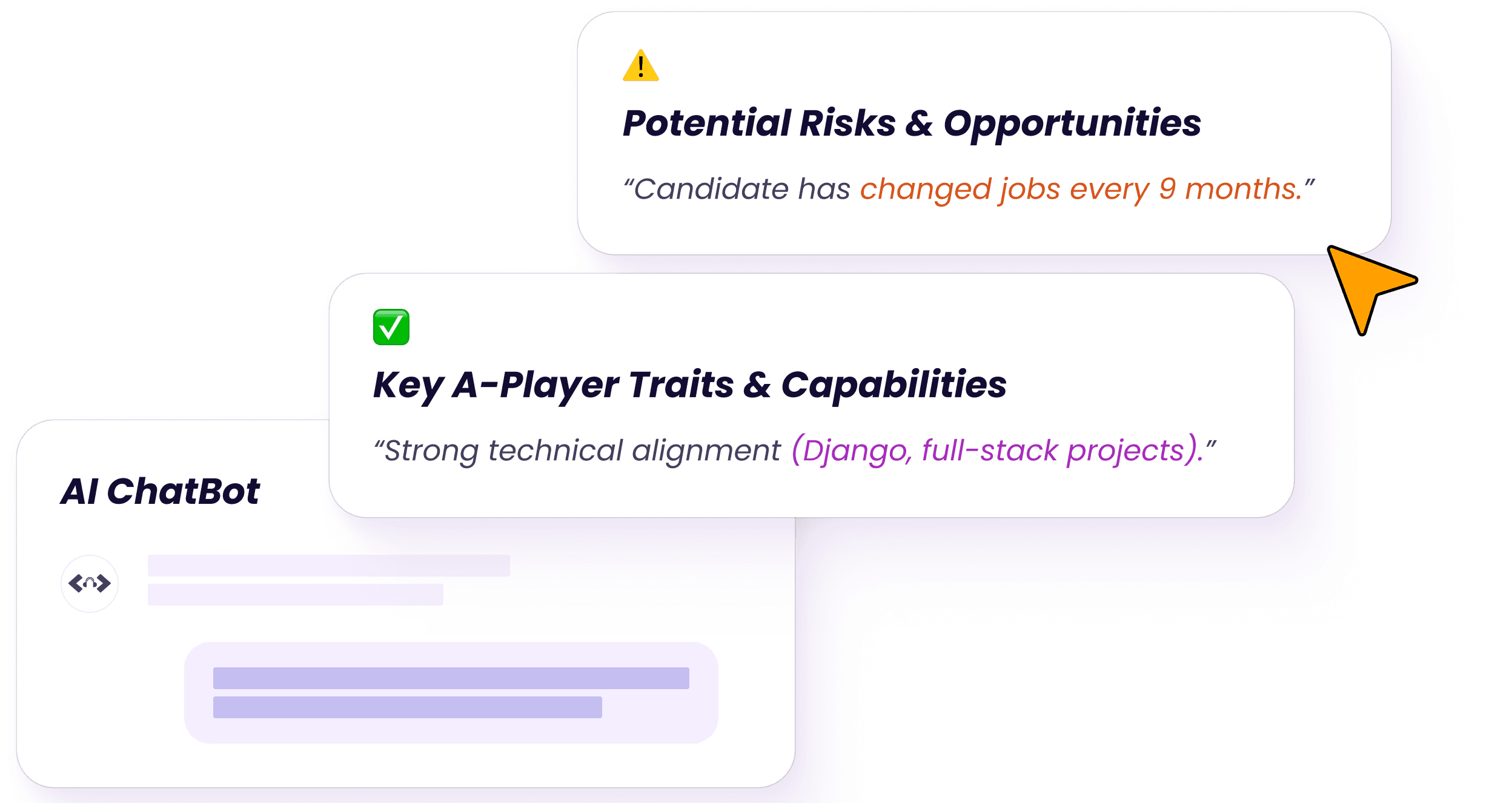
Let AgentR surface the patterns, risks, and opportunities, while you focus on the people.
Great hiring starts with great decisions.
Let AgentR surface the patterns, risks, and opportunities, while you focus on the people.
Great hiring starts with great decisions.
Let AgentR surface the patterns, risks, and opportunities, while you focus on the people.
2026 AgentR, All rights reserved