Humans + Agents: The Case Against Fully Automated Hiring
Humans + Agents: The Case Against Fully Automated Hiring
Humans + Agents: The Case Against Fully Automated Hiring
AI can do a great deal in recruiting. Making the final call on a person's potential isn't one of them.
AI can do a great deal in recruiting. Making the final call on a person's potential isn't one of them.
AI can do a great deal in recruiting. Making the final call on a person's potential isn't one of them.
5 min read
5 min read
5 min read
Get weekly updates
Get weekly updates
Ethics & Bias
Ethics & Bias
Ethics & Bias
Published on:
Published on:
Published on:
Read Time:
Read Time:
Read Time:
Category:
Category:
Category:
There is a version of the AI hiring future that is technically possible and genuinely wrong.
Every CV processed autonomously. Thousands of interviews conducted simultaneously by AI agents. Shortlists generated, ranked, and delivered to hiring managers without a human recruiter involved at any stage. The pitch is compelling in the abstract: infinite scale, consistent evaluation, zero recruiter bandwidth consumed.
Some vendors are already selling this future. The argument is that AI removes bias, increases throughput, and eliminates the inconsistency of human judgment. Why have a recruiter screen 400 applications when an AI can do it better in seconds?
Here's why:
What Hiring is Actually For?
Hiring is not a classification problem.
A classification problem has a correct answer that an algorithm can learn to approximate with enough training data. Spam detection is a classification problem. Fraud detection is a classification problem. Resume parsing, extracting structured data from unstructured documents, is a classification problem.
Hiring is an assessment of potential under uncertainty. You are trying to make a judgment about how a person will perform in a specific context, with a specific team, at a specific point in a company's development a ,context that doesn't fully exist yet when the hire is made. The "right answer" isn't knowable in advance. It can only be evaluated retrospectively, and even then it's entangled with factors that have nothing to do with the hiring decision.
This distinction matters because it determines what kind of tool is appropriate. Classification problems get better with more data and more sophisticated models. Assessment problems under uncertainty require human judgment, not because humans are more accurate than algorithms in every dimension, but because the exercise of judgment is part of what's being done. A hiring decision is also a human relationship. The candidate who is assessed, interviewed, and hired by a process that involves genuine human attention has a different experience, and a different subsequent relationship with the organisation, than one processed by an automated system they never meaningfully interact with.
What the Data Says About Human-AI Collaboration?
The evidence on AI in hiring consistently points in the same direction: AI improves human decisions, but does not replace them.
AI tools that surface non-obvious candidate signals, flag patterns a human reviewer might miss, identify candidates who were buried in a large pool, these produce better outcomes than unaided human review at scale. The AI extends human capacity.
AI tools that make terminal decisions, that filter candidates out before any human sees them, or that rank candidates in ways that humans then rubber-stamp without meaningful review, produce the same failures as purely human systems, with the addition of scale, speed, and the false authority of algorithmic objectivity.
The University of Washington's research on this is telling: when people know an AI system has shown bias, they still follow its recommendations. The authority of a score, a ranking, a system-generated output is powerful enough to override human judgment even when the human knows the system has limitations. Which means "AI-assisted" hiring is only genuinely better than pure AI hiring if the humans involved are meaningfully engaging with the AI's outputs, not just ratifying them.
This requires explainable AI. A system that tells a recruiter what it found and why invites genuine engagement. A system that produces a rank-ordered list without reasoning produces compliance.
The Legal Landscape is Catching Up
The regulatory environment around automated hiring decisions is developing quickly, and the direction of travel is clear.
The Colorado AI Act, effective February 2026, requires companies using AI in high-stakes decisions — including employment, to conduct impact assessments, notify affected individuals, and provide meaningful opportunity to correct errors. Illinois' Artificial Intelligence Video Interview Act requires explicit disclosure when AI is used to evaluate video interviews. New York City's Local Law 144 mandates bias audits for automated employment decision tools.
The EU AI Act classifies employment-related AI as high-risk, imposing significant transparency and human oversight requirements.
These regulations share a common thread: they assume humans are in the decision loop in a meaningful way. They require that AI-assisted decisions be explainable, auditable, and subject to human review. An end-to-end automated hiring process is, in many jurisdictions, already legally problematic, and the regulatory environment will tighten further as the technology becomes more prevalent.
The practical implication is simple: any hiring technology strategy that doesn't have meaningful human oversight at key decision points is not just philosophically questionable. It's a growing legal exposure.
What "Humans + Agents" Actually Means?
The Humans + Agents model isn't a soft compromise between full automation and manual review. It's a specific design principle about where AI adds value and where it doesn't.
AI is genuinely superior at scale tasks that require consistency: processing a high volume of applications without fatigue, surfacing candidates who match non-obvious patterns, generating structured assessment frameworks, capturing and organising information from interviews, identifying inconsistencies in candidate data, scheduling and coordination. These tasks consume enormous recruiter time and produce variable results when done manually. AI handles them better.
Humans are genuinely superior at judgment calls that require context: evaluating whether a non-standard background represents genuine capability or simply an unusual path, assessing the credibility and texture of interview responses, deciding whether a candidate who is formally underqualified represents a high-potential bet worth making, reading the interpersonal fit signals that no document or structured interview fully captures. These judgments cannot be reliably encoded in a model. They require a human with relevant context and the authority to use it.
The design principle is: use AI to expand the range of what human judgment can operate over, not to replace human judgment at the moment of decision.
The Candidate on the Other Side
There is a dimension to this that is not about accuracy or efficiency or legal compliance. It's about what it means to be on the receiving end of a hiring process.
A candidate who applies to a company, engages with an AI phone screen, receives an AI-generated assessment report, and either advances or doesn't without ever speaking to a human being — that candidate's experience of the company is shaped entirely by their interaction with the automation. The conclusion they draw, whether they get the job or not, is that they were processed, not considered.
Employer brand is built in these moments. The candidate who didn't get the job but felt genuinely evaluated refers others and applies again. The candidate who felt processed tells their network what it was like.
In a market where talent communities are small and reputations travel fast, how you make people feel when they apply is not a soft consideration. It's a competitive differentiator.
Agents handle the scale. Humans make the call. That's not a limitation of current AI. That's the right design for something this important.
There is a version of the AI hiring future that is technically possible and genuinely wrong.
Every CV processed autonomously. Thousands of interviews conducted simultaneously by AI agents. Shortlists generated, ranked, and delivered to hiring managers without a human recruiter involved at any stage. The pitch is compelling in the abstract: infinite scale, consistent evaluation, zero recruiter bandwidth consumed.
Some vendors are already selling this future. The argument is that AI removes bias, increases throughput, and eliminates the inconsistency of human judgment. Why have a recruiter screen 400 applications when an AI can do it better in seconds?
Here's why:
What Hiring is Actually For?
Hiring is not a classification problem.
A classification problem has a correct answer that an algorithm can learn to approximate with enough training data. Spam detection is a classification problem. Fraud detection is a classification problem. Resume parsing, extracting structured data from unstructured documents, is a classification problem.
Hiring is an assessment of potential under uncertainty. You are trying to make a judgment about how a person will perform in a specific context, with a specific team, at a specific point in a company's development a ,context that doesn't fully exist yet when the hire is made. The "right answer" isn't knowable in advance. It can only be evaluated retrospectively, and even then it's entangled with factors that have nothing to do with the hiring decision.
This distinction matters because it determines what kind of tool is appropriate. Classification problems get better with more data and more sophisticated models. Assessment problems under uncertainty require human judgment, not because humans are more accurate than algorithms in every dimension, but because the exercise of judgment is part of what's being done. A hiring decision is also a human relationship. The candidate who is assessed, interviewed, and hired by a process that involves genuine human attention has a different experience, and a different subsequent relationship with the organisation, than one processed by an automated system they never meaningfully interact with.
What the Data Says About Human-AI Collaboration?
The evidence on AI in hiring consistently points in the same direction: AI improves human decisions, but does not replace them.
AI tools that surface non-obvious candidate signals, flag patterns a human reviewer might miss, identify candidates who were buried in a large pool, these produce better outcomes than unaided human review at scale. The AI extends human capacity.
AI tools that make terminal decisions, that filter candidates out before any human sees them, or that rank candidates in ways that humans then rubber-stamp without meaningful review, produce the same failures as purely human systems, with the addition of scale, speed, and the false authority of algorithmic objectivity.
The University of Washington's research on this is telling: when people know an AI system has shown bias, they still follow its recommendations. The authority of a score, a ranking, a system-generated output is powerful enough to override human judgment even when the human knows the system has limitations. Which means "AI-assisted" hiring is only genuinely better than pure AI hiring if the humans involved are meaningfully engaging with the AI's outputs, not just ratifying them.
This requires explainable AI. A system that tells a recruiter what it found and why invites genuine engagement. A system that produces a rank-ordered list without reasoning produces compliance.
The Legal Landscape is Catching Up
The regulatory environment around automated hiring decisions is developing quickly, and the direction of travel is clear.
The Colorado AI Act, effective February 2026, requires companies using AI in high-stakes decisions — including employment, to conduct impact assessments, notify affected individuals, and provide meaningful opportunity to correct errors. Illinois' Artificial Intelligence Video Interview Act requires explicit disclosure when AI is used to evaluate video interviews. New York City's Local Law 144 mandates bias audits for automated employment decision tools.
The EU AI Act classifies employment-related AI as high-risk, imposing significant transparency and human oversight requirements.
These regulations share a common thread: they assume humans are in the decision loop in a meaningful way. They require that AI-assisted decisions be explainable, auditable, and subject to human review. An end-to-end automated hiring process is, in many jurisdictions, already legally problematic, and the regulatory environment will tighten further as the technology becomes more prevalent.
The practical implication is simple: any hiring technology strategy that doesn't have meaningful human oversight at key decision points is not just philosophically questionable. It's a growing legal exposure.
What "Humans + Agents" Actually Means?
The Humans + Agents model isn't a soft compromise between full automation and manual review. It's a specific design principle about where AI adds value and where it doesn't.
AI is genuinely superior at scale tasks that require consistency: processing a high volume of applications without fatigue, surfacing candidates who match non-obvious patterns, generating structured assessment frameworks, capturing and organising information from interviews, identifying inconsistencies in candidate data, scheduling and coordination. These tasks consume enormous recruiter time and produce variable results when done manually. AI handles them better.
Humans are genuinely superior at judgment calls that require context: evaluating whether a non-standard background represents genuine capability or simply an unusual path, assessing the credibility and texture of interview responses, deciding whether a candidate who is formally underqualified represents a high-potential bet worth making, reading the interpersonal fit signals that no document or structured interview fully captures. These judgments cannot be reliably encoded in a model. They require a human with relevant context and the authority to use it.
The design principle is: use AI to expand the range of what human judgment can operate over, not to replace human judgment at the moment of decision.
The Candidate on the Other Side
There is a dimension to this that is not about accuracy or efficiency or legal compliance. It's about what it means to be on the receiving end of a hiring process.
A candidate who applies to a company, engages with an AI phone screen, receives an AI-generated assessment report, and either advances or doesn't without ever speaking to a human being — that candidate's experience of the company is shaped entirely by their interaction with the automation. The conclusion they draw, whether they get the job or not, is that they were processed, not considered.
Employer brand is built in these moments. The candidate who didn't get the job but felt genuinely evaluated refers others and applies again. The candidate who felt processed tells their network what it was like.
In a market where talent communities are small and reputations travel fast, how you make people feel when they apply is not a soft consideration. It's a competitive differentiator.
Agents handle the scale. Humans make the call. That's not a limitation of current AI. That's the right design for something this important.

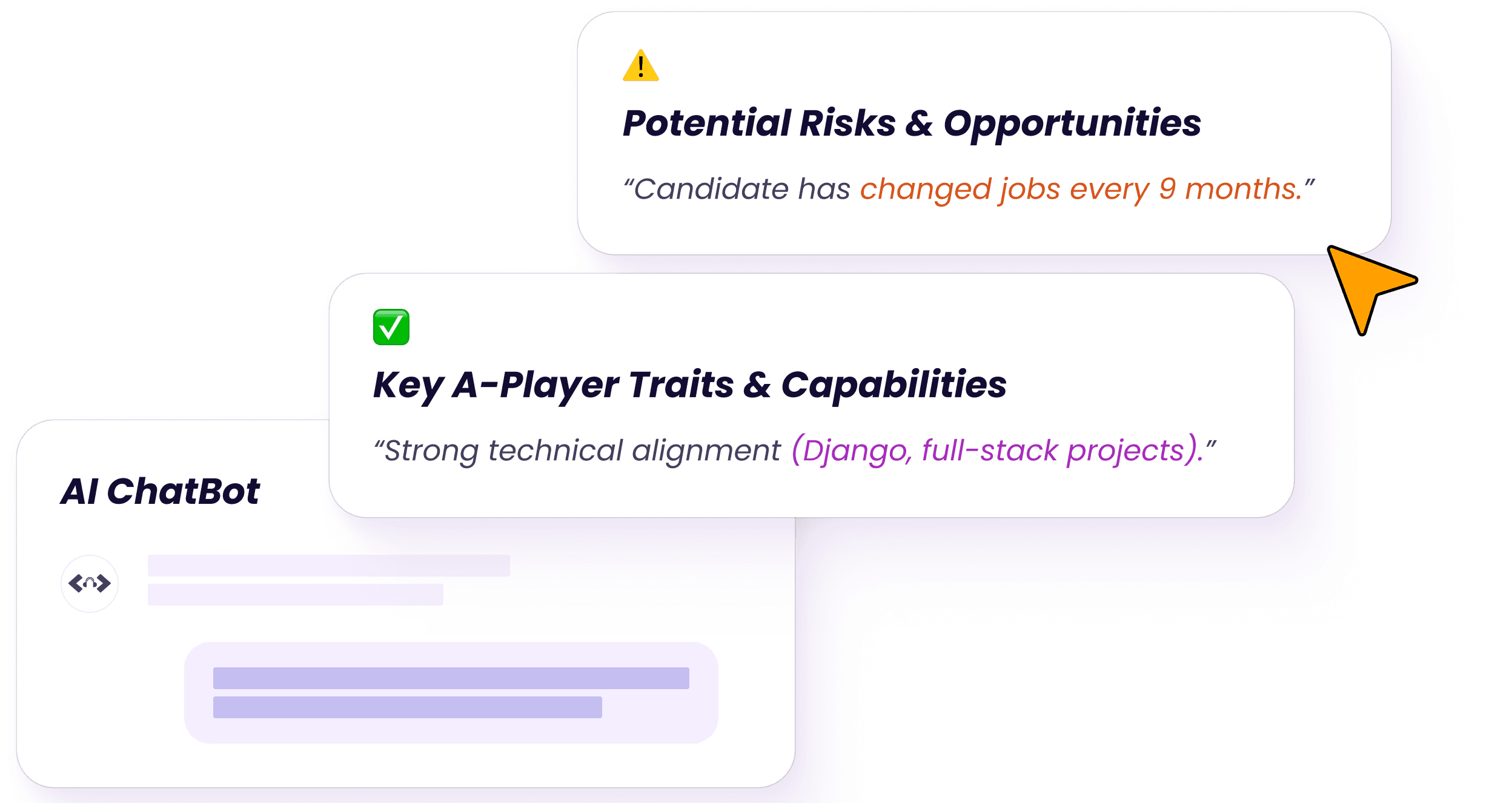
Great hiring starts with great decisions.
Let AgentR surface the patterns, risks, and opportunities, while you focus on the people.
Great hiring starts with great decisions.
Let AgentR surface the patterns, risks, and opportunities, while you focus on the people.
Great hiring starts with great decisions.
Let AgentR surface the patterns, risks, and opportunities, while you focus on the people.
2026 AgentR, All rights reserved