India Hires 10 Million Freshers a Year and Has No Intelligence Layer for It
India Hires 10 Million Freshers a Year and Has No Intelligence Layer for It
India Hires 10 Million Freshers a Year and Has No Intelligence Layer for It
The world's most complex hiring challenge is being managed with the world's most outdated tools.
The world's most complex hiring challenge is being managed with the world's most outdated tools.
The world's most complex hiring challenge is being managed with the world's most outdated tools.

5 min read
5 min read
5 min read
Get weekly updates
Get weekly updates
Research
Research
Research
Published on:
Published on:
Published on:
Read Time:
Read Time:
Read Time:
Category:
Category:
Category:
Every year, roughly 10 million graduates enter India's job market.
Not 10 million applications. 10 million people. Each one carrying a degree, a set of expectations, and a trajectory that will be shaped significantly by the first role they land and how they land it.
The companies on the other side of that equation, IT services firms, banks, manufacturing conglomerates, startups, run hiring operations at a scale that has no equivalent anywhere else in the world. Infosys hires more people in a single quarter than most European companies employ in total. The TCS campus recruitment cycle spans hundreds of colleges, thousands of roles, and hundreds of thousands of applications in a window of a few months.
And the dominant technology managing this entire process? Spreadsheets, email, and ATS systems built for US corporate hiring in the early 2010s.
India has the world's most complex hiring challenge and essentially no intelligence infrastructure built for it.
Why the Global Tools Don't Fit?
The ATS ecosystem, Greenhouse, Lever, Ashby, Workable, was designed for a specific hiring context. A company with 50–500 open roles at any time, mostly experience hires, in a market where candidates have LinkedIn profiles and prior employment histories that can be evaluated in structured ways.
That context describes almost none of India's largest hiring problems.
Campus hiring at scale operates completely differently. The candidate has no employment history. Their resume is two pages of education, internships, and extracurriculars. The differentiating signals are grades, college tier, project work, and some early indicator of aptitude and drive. The volume is enormous, the timelines are compressed, and the decisions carry enormous consequences, both for the candidate and for the company, which is essentially making a bet on potential rather than demonstrated performance.
Global tools are not built for this. They parse employment history. They match keywords against job descriptions. Applied to freshers, they either fail silently, producing outputs that have no signal value, or they systematically bias toward candidates from elite colleges whose profiles happen to look like the training data.
The companies that know this work around it. They build internal systems, run Excel-based tracking, develop proprietary assessment frameworks. The workarounds are labour-intensive, inconsistent, and entirely disconnected from any learning feedback loop.
The Offer Dropout Problem Nobody Talks About Publicly
India's hiring has a downstream problem that is rarely discussed openly: offer dropout rates of 30–40% are common, and in some sectors, particularly IT services for freshers, they are structurally embedded in the process.
Companies extend more offers than they need because they know a substantial proportion won't convert. Candidates accept multiple offers simultaneously because they know the system expects them to. The result is a phantom hiring market: thousands of accepted offers that were never real commitments on either side, creating administrative overhead, misaligned capacity planning, and deep erosion of trust.
Global talent analytics tools don't address this because they weren't built to model it. The offer dropout phenomenon requires understanding candidate intent signals, communication patterns, engagement with pre-boarding content, responses to check-ins, social signals about other applications in progress and building a predictive model of who is genuinely committed versus who is holding the offer as an option.
This is an entirely solvable problem with the right data infrastructure. It is completely unsolved with the tools currently available to most Indian hiring teams.
The Notice Period Distortion
India's 60–90 day notice period norm creates a different kind of problem: it makes experience hire pipelines extraordinarily difficult to manage with standard ATS tools.
A recruiter making an offer to an experience candidate in the US or UK operates on a 2–4 week joining timeline. They can manage one pipeline for the role and close it cleanly.
An Indian recruiter making an offer to a mid-level professional operates on a 60–90 day timeline, during which a significant proportion of candidates will receive counter-offers from their current employer, continue interviewing elsewhere, or simply change their mind. The joining is not confirmed until they walk through the door. Sometimes not even then.
Managing this requires a fundamentally different pipeline model on,e that maintains engagement over a 90-day period, tracks signals of commitment, identifies at-risk candidates before they drop, and intelligently manages backup pipeline without wasting recruiter time. Standard ATS tools treat the offer stage as the end of the process. In India, it's the beginning of a 90-day retention challenge with a candidate you haven't technically hired yet.
Tier-2 and Tier-3 Talent: Invisible to the Current Infrastructure
Here's a signal that is almost universally missed in Indian hiring intelligence: the relationship between college tier and performance is weaker than hiring behavior implies.
The IITs, NITs, and top private engineering colleges dominate campus hiring attention disproportionately relative to their output. The 95% of Indian engineering graduates who come from tier-2 and tier-3 colleges and who constitute the actual workforce of almost every major IT services company are evaluated with far less rigour, through processes that generate far less data, by teams with far fewer resources.
The implicit logic is that tier-1 institutions are a reliable quality signal. And they are for a certain type of high-achiever who thrives in structured academic competition. But the qualities most relevant to performance in many Indian corporate environments, adaptability, problem-solving under constraint, ability to learn quickly without formal structure, resilience are not uniquely concentrated in elite colleges.
A hiring intelligence system built for India should be doing two things it currently cannot: building better signal models for tier-2 and tier-3 candidates, and tracking the post-hire performance of hires from different institutional backgrounds rigorously enough to calibrate those models over time.
Neither is happening at any meaningful scale. The data exists, performance management systems in large companies have it. It's just not connected to the hiring function in any way that allows learning.
The Content Gap
There is one more dimension to this problem that is less about technology and more about knowledge.
The global HR technology content ecosystem, the thought leadership, the research, the practitioner communities, is overwhelmingly US-centric. Greenhouse publishes data about American hiring markets. LinkedIn's research reflects global but largely Western workforce trends. The talent acquisition communities where ideas circulate are populated by practitioners from markets where the structural challenges look nothing like India's.
Indian HR professionals navigating the specific challenges of campus recruitment at scale, 90-day notice periods, 40% offer dropout rates, and tier-2 talent sourcing have almost nowhere to look for frameworks developed for their context. The best they can do is adapt tools and ideas from markets that face fundamentally different problems.
This is the content gap. Not just a technology gap, a knowledge infrastructure gap.
The companies and thinkers who develop rigorous, India-specific hiring intelligence, who study what actually predicts performance in the Indian context, who build frameworks for campus evaluation that go beyond college tier, who address the offer dropout problem with data rather than gut feel, will not just be writing interesting articles. They will be filling a vacuum that affects millions of hiring decisions and, through those decisions, millions of careers.
What India-specific Hiring Intelligence would Actually Look Like?
It starts with acknowledging that fresher evaluation requires a completely different framework from experience hire evaluation. Potential signals learning agility, problem-solving approach, adaptability indicators, need to be developed for candidates who have essentially no track record. Validated, context-specific assessments built for the Indian education system's outputs are not the same as global graduate assessment tools with Hindi instructions.
It continues with building the offer-to-joining pipeline as a serious product problem, not an administrative one. Predictive models for offer dropout, engagement tracking through the notice period, intelligent back-pipeline management, these are data problems with data solutions.
And it requires connecting post-hire performance data to pre-hire decisions in a way that generates actual learning. Which colleges, which assessment signals, which interview dimensions are actually predictive of performance in this company, in this role, in this context? The answer is not the same across companies, or even across business units within the same company. It has to be built from data, which means the data has to be collected, connected, and analyzed.
Ten million people enter the Indian job market every year. The quality of the decisions made about them by both candidates and companies, shapes careers, builds or wastes organisational capability, and either does or doesn't develop the human capital that the next phase of India's economic development depends on.
Managing that with spreadsheets and borrowed tools is not a resource constraint. It's a choice. And it's one that gets more expensive every year
Every year, roughly 10 million graduates enter India's job market.
Not 10 million applications. 10 million people. Each one carrying a degree, a set of expectations, and a trajectory that will be shaped significantly by the first role they land and how they land it.
The companies on the other side of that equation, IT services firms, banks, manufacturing conglomerates, startups, run hiring operations at a scale that has no equivalent anywhere else in the world. Infosys hires more people in a single quarter than most European companies employ in total. The TCS campus recruitment cycle spans hundreds of colleges, thousands of roles, and hundreds of thousands of applications in a window of a few months.
And the dominant technology managing this entire process? Spreadsheets, email, and ATS systems built for US corporate hiring in the early 2010s.
India has the world's most complex hiring challenge and essentially no intelligence infrastructure built for it.
Why the Global Tools Don't Fit?
The ATS ecosystem, Greenhouse, Lever, Ashby, Workable, was designed for a specific hiring context. A company with 50–500 open roles at any time, mostly experience hires, in a market where candidates have LinkedIn profiles and prior employment histories that can be evaluated in structured ways.
That context describes almost none of India's largest hiring problems.
Campus hiring at scale operates completely differently. The candidate has no employment history. Their resume is two pages of education, internships, and extracurriculars. The differentiating signals are grades, college tier, project work, and some early indicator of aptitude and drive. The volume is enormous, the timelines are compressed, and the decisions carry enormous consequences, both for the candidate and for the company, which is essentially making a bet on potential rather than demonstrated performance.
Global tools are not built for this. They parse employment history. They match keywords against job descriptions. Applied to freshers, they either fail silently, producing outputs that have no signal value, or they systematically bias toward candidates from elite colleges whose profiles happen to look like the training data.
The companies that know this work around it. They build internal systems, run Excel-based tracking, develop proprietary assessment frameworks. The workarounds are labour-intensive, inconsistent, and entirely disconnected from any learning feedback loop.
The Offer Dropout Problem Nobody Talks About Publicly
India's hiring has a downstream problem that is rarely discussed openly: offer dropout rates of 30–40% are common, and in some sectors, particularly IT services for freshers, they are structurally embedded in the process.
Companies extend more offers than they need because they know a substantial proportion won't convert. Candidates accept multiple offers simultaneously because they know the system expects them to. The result is a phantom hiring market: thousands of accepted offers that were never real commitments on either side, creating administrative overhead, misaligned capacity planning, and deep erosion of trust.
Global talent analytics tools don't address this because they weren't built to model it. The offer dropout phenomenon requires understanding candidate intent signals, communication patterns, engagement with pre-boarding content, responses to check-ins, social signals about other applications in progress and building a predictive model of who is genuinely committed versus who is holding the offer as an option.
This is an entirely solvable problem with the right data infrastructure. It is completely unsolved with the tools currently available to most Indian hiring teams.
The Notice Period Distortion
India's 60–90 day notice period norm creates a different kind of problem: it makes experience hire pipelines extraordinarily difficult to manage with standard ATS tools.
A recruiter making an offer to an experience candidate in the US or UK operates on a 2–4 week joining timeline. They can manage one pipeline for the role and close it cleanly.
An Indian recruiter making an offer to a mid-level professional operates on a 60–90 day timeline, during which a significant proportion of candidates will receive counter-offers from their current employer, continue interviewing elsewhere, or simply change their mind. The joining is not confirmed until they walk through the door. Sometimes not even then.
Managing this requires a fundamentally different pipeline model on,e that maintains engagement over a 90-day period, tracks signals of commitment, identifies at-risk candidates before they drop, and intelligently manages backup pipeline without wasting recruiter time. Standard ATS tools treat the offer stage as the end of the process. In India, it's the beginning of a 90-day retention challenge with a candidate you haven't technically hired yet.
Tier-2 and Tier-3 Talent: Invisible to the Current Infrastructure
Here's a signal that is almost universally missed in Indian hiring intelligence: the relationship between college tier and performance is weaker than hiring behavior implies.
The IITs, NITs, and top private engineering colleges dominate campus hiring attention disproportionately relative to their output. The 95% of Indian engineering graduates who come from tier-2 and tier-3 colleges and who constitute the actual workforce of almost every major IT services company are evaluated with far less rigour, through processes that generate far less data, by teams with far fewer resources.
The implicit logic is that tier-1 institutions are a reliable quality signal. And they are for a certain type of high-achiever who thrives in structured academic competition. But the qualities most relevant to performance in many Indian corporate environments, adaptability, problem-solving under constraint, ability to learn quickly without formal structure, resilience are not uniquely concentrated in elite colleges.
A hiring intelligence system built for India should be doing two things it currently cannot: building better signal models for tier-2 and tier-3 candidates, and tracking the post-hire performance of hires from different institutional backgrounds rigorously enough to calibrate those models over time.
Neither is happening at any meaningful scale. The data exists, performance management systems in large companies have it. It's just not connected to the hiring function in any way that allows learning.
The Content Gap
There is one more dimension to this problem that is less about technology and more about knowledge.
The global HR technology content ecosystem, the thought leadership, the research, the practitioner communities, is overwhelmingly US-centric. Greenhouse publishes data about American hiring markets. LinkedIn's research reflects global but largely Western workforce trends. The talent acquisition communities where ideas circulate are populated by practitioners from markets where the structural challenges look nothing like India's.
Indian HR professionals navigating the specific challenges of campus recruitment at scale, 90-day notice periods, 40% offer dropout rates, and tier-2 talent sourcing have almost nowhere to look for frameworks developed for their context. The best they can do is adapt tools and ideas from markets that face fundamentally different problems.
This is the content gap. Not just a technology gap, a knowledge infrastructure gap.
The companies and thinkers who develop rigorous, India-specific hiring intelligence, who study what actually predicts performance in the Indian context, who build frameworks for campus evaluation that go beyond college tier, who address the offer dropout problem with data rather than gut feel, will not just be writing interesting articles. They will be filling a vacuum that affects millions of hiring decisions and, through those decisions, millions of careers.
What India-specific Hiring Intelligence would Actually Look Like?
It starts with acknowledging that fresher evaluation requires a completely different framework from experience hire evaluation. Potential signals learning agility, problem-solving approach, adaptability indicators, need to be developed for candidates who have essentially no track record. Validated, context-specific assessments built for the Indian education system's outputs are not the same as global graduate assessment tools with Hindi instructions.
It continues with building the offer-to-joining pipeline as a serious product problem, not an administrative one. Predictive models for offer dropout, engagement tracking through the notice period, intelligent back-pipeline management, these are data problems with data solutions.
And it requires connecting post-hire performance data to pre-hire decisions in a way that generates actual learning. Which colleges, which assessment signals, which interview dimensions are actually predictive of performance in this company, in this role, in this context? The answer is not the same across companies, or even across business units within the same company. It has to be built from data, which means the data has to be collected, connected, and analyzed.
Ten million people enter the Indian job market every year. The quality of the decisions made about them by both candidates and companies, shapes careers, builds or wastes organisational capability, and either does or doesn't develop the human capital that the next phase of India's economic development depends on.
Managing that with spreadsheets and borrowed tools is not a resource constraint. It's a choice. And it's one that gets more expensive every year

Great hiring starts with great decisions.
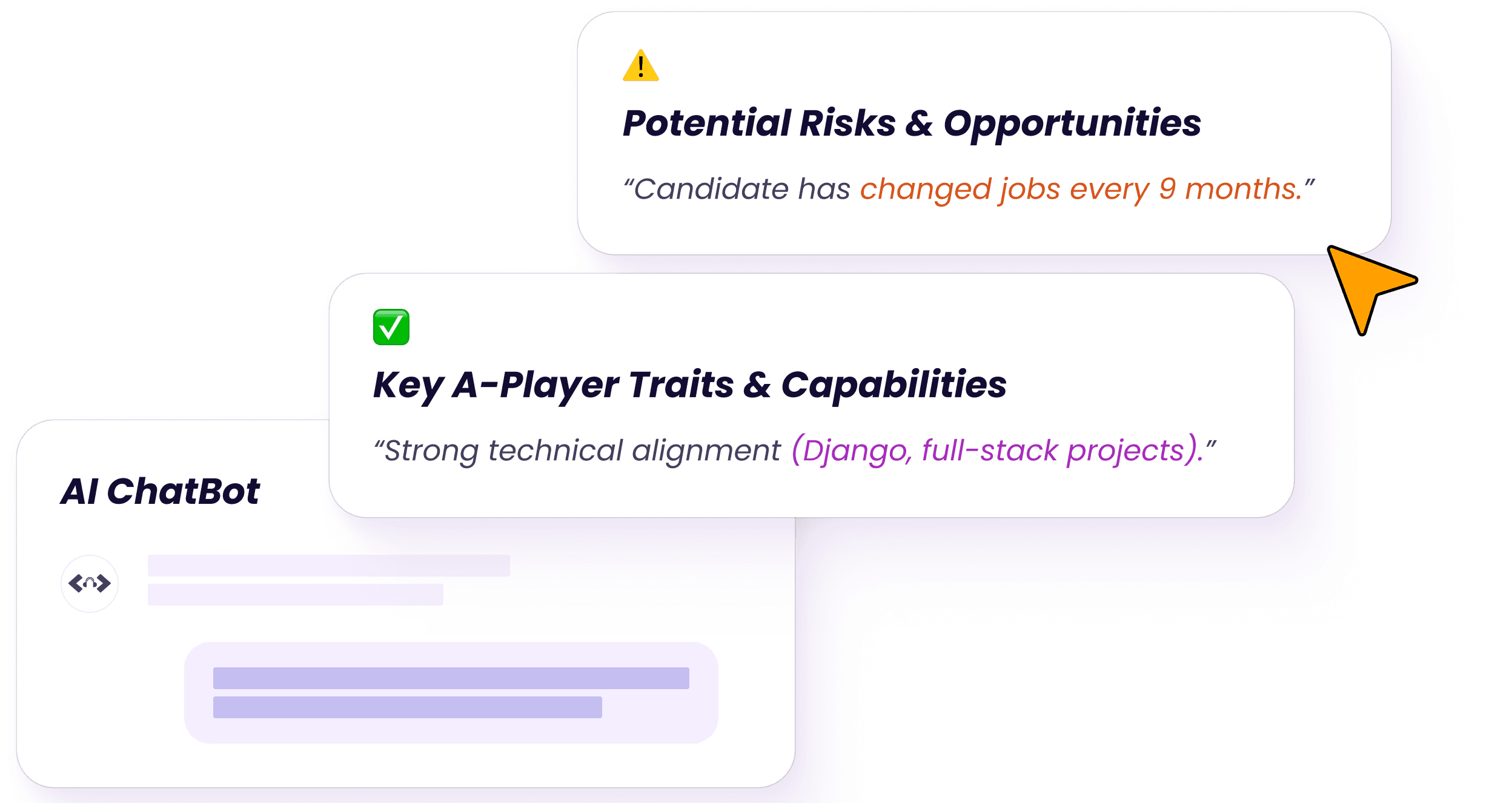
Let AgentR surface the patterns, risks, and opportunities, while you focus on the people.
Great hiring starts with great decisions.
Let AgentR surface the patterns, risks, and opportunities, while you focus on the people.
Great hiring starts with great decisions.
Let AgentR surface the patterns, risks, and opportunities, while you focus on the people.
2026 AgentR, All rights reserved