Skills-Based Hiring Is a PR Strategy, Not a Hiring Strategy
Skills-Based Hiring Is a PR Strategy, Not a Hiring Strategy
Skills-Based Hiring Is a PR Strategy, Not a Hiring Strategy
The data gap between what companies announce and what they actually do is wider than anyone is admitting.
The data gap between what companies announce and what they actually do is wider than anyone is admitting.
The data gap between what companies announce and what they actually do is wider than anyone is admitting.
5 min read
5 min read
5 min read
Get weekly updates
Get weekly updates
Opinions
Opinions
Opinions
Published on:
Published on:
Published on:
Read Time:
Read Time:
Read Time:
Category:
Category:
Category:
Something unusual happened in corporate America around 2022.
Companies started making announcements. Big ones. IBM dropped degree requirements for more than half its U.S. roles. Apple followed. Google, Delta, Bank of America, Walmart, Tesla, the list of names grew until it looked like the end of credential-based hiring was not a question of whether, but when. LinkedIn ran breathless coverage. HR publications declared the four-year degree officially dead. “Skills-based hiring” became the phrase that every CHRO wanted associated with their organisation.
It was a genuinely compelling story. There were real problems driving it, decades of credential inflation that had priced out capable workers for no defensible reason, a labour market with a mismatch between available talent and required credentials, 70 million Americans the Harvard Business School called “hidden workers” who possessed the relevant skills but lacked the letters that would get them through the filter.
The story made sense. The announcements were real. The policy changes were documented.
And then Harvard and the Burning Glass Institute looked at the actual hiring data, and found something that didn’t match the story at all.
What the Numbers Actually Show?
In 2024, Harvard Business School and the Burning Glass Institute published the most rigorous examination of skills-based hiring practice to date. They didn’t study what companies said. They studied what companies did, tracking actual hiring outcomes across organisations that had publicly committed to removing degree requirements.
The headline finding was stark.
Of the 77 million hires made annually in the U.S., the number of people hired into roles where they would previously have been screened out for lacking a degree was approximately 97,000. That’s the entire impact of the skills-based hiring movement, measured in actual human beings who got jobs they otherwise wouldn’t have.
Fewer than 1 in 700 hires.
Put another way: 85% of employers report using skills-based hiring. 53% have removed degree requirements from at least some job postings. And the real-world impact on who actually gets hired amounts to a rounding error.
The researchers were precise about why. They categorised the companies in their sample into three groups. Skills-based Hiring Leaders, 37% of firms, had genuinely changed their practices, increasing their share of non-degreed hires by an average of 18%. These are the organisations where the announcement corresponded to an actual shift in who got interviewed, who got offers, and who got jobs.
Then there were the Backsliders. 18% of companies had made initial changes after dropping degree requirements, briefly increased their share of non-degreed hires, and then quietly reverted to previous patterns within 12 to 18 months. The policy stayed on the careers page. The practice did not.
And then there was the largest group. 45% of the companies studied were classified as “In-Name-Only.” They had changed their words. They had not changed their actions. Degree preferences remained embedded in their hiring manager behaviour, their interview structures, their offer decisions, everything below the level of the press release remained untouched.
Nearly half of the companies that made public commitments to skills-based hiring changed nothing that mattered.
The Degree has been Inflating for Decades, in the Opposite Direction
Here’s the irony that makes this story particularly sharp.
At the same moment that companies were publicly committing to skills-based hiring, a separate phenomenon was moving in the exact opposite direction: credential creep, the quiet expansion of degree requirements into roles that had never required them.
The data on this is not subtle. In the late 1990s, fewer than 20% of executive-assistant postings required a bachelor’s degree. Among current employees actually doing the job, that figure was similar, the role historically did not require a degree, and the people succeeding in it reflected that. By the early 2020s, bachelor’s degree requirements appeared in 65% of executive-assistant job postings.
The tasks had not changed. The credential requirement had tripled.
This pattern repeats across mid-skill roles, help-desk technicians, office administrators, research aides, frontline supervisors, field service coordinators. The work is the same. The paper required to be considered for it is not. A 2025 analysis by Whatjobs found that employers across sectors are now requiring master’s degrees for roles that were entry-level five years ago, even when the underlying job function has no material difference.
Credential inflation and skills-based hiring are simultaneous movements happening within the same organisations, sometimes within the same HR function. One team is announcing that degrees don’t matter. Another is quietly adding them to job descriptions as a filter because it reduces the volume of applications to a manageable number.
Both of these things can be true at once. And they are.
Why Companies Announce What They Don’t Do?
The “in-name-only” category isn’t a mystery. The incentive structure that produces it is legible.
Removing degree requirements costs nothing and generates significant positive coverage. It signals social responsibility. It tells the talent market that your organisation is progressive, accessible, and focused on potential rather than pedigree. It gives your recruitment marketing team a story that differentiates you from competitors who haven’t made the same announcement.
None of this requires the company to actually hire differently.
The announcement and the implementation are separated by an enormous operational gap. Removing a checkbox on a job posting form does not retrain hiring managers who were promoted, in part, for having the degree they now nominally don’t require. It does not change the implicit evaluation heuristics that screen out non-traditional candidates at the resume review stage, before a human ever sees them. It does not change the interview question frameworks that favour candidates from educational environments that developed certain vocabulary and presentation styles. It does not change the reference network dynamics that advantage candidates who attended the same institutions as the people making hiring decisions.
The checkbox was not the barrier. The checkbox was a symptom. The barrier is a hiring culture that was built around credentials and that will continue to express credential preference through every informal mechanism available to it, regardless of what the official policy says.
McKinsey’s research puts the cost of this misalignment in sharp relief. Skills-based evaluation, actual measurement of whether a candidate can do the work, is five times more predictive of job performance than education-level alone. The companies that have genuinely implemented it report 25% higher performance ratings in their hires and 40% lower turnover. The outcome evidence is not ambiguous.
But evidence of better outcomes does not automatically produce adoption of better practices. Especially when the practices that produce worse outcomes carry less organisational friction.
The Hidden Workers Problem Isn’t Shrinking
The 70 million “hidden workers” figure from Harvard and Accenture, American workers with relevant skills who are systematically screened out before any human evaluation because their credentials don’t match an automated filter, has not meaningfully improved.
Because it was never fundamentally an HR policy problem. It was an infrastructure problem.
The ATS filters that eliminate non-degreed candidates weren’t changed by press releases. They were changed, when they were changed, only by deliberate technical reconfiguration, and 45% of the companies that said they were changing them apparently didn’t get around to it. The hiring managers who see a non-degreed candidate in their pipeline and react with mild unease, an unease that influences their evaluation without surfacing as explicit bias, weren’t retrained by a corporate announcement. The interview loops that reward candidates whose vocabulary and presentational confidence signal elite institutional training weren’t restructured.
The people who were hidden before the movement are mostly still hidden.
This matters beyond the individual cost to each candidate who is being evaluated on something other than their ability to do the job. It matters because organisations making hiring decisions based on proxies for capability, proxies that systematically exclude large populations for structural rather than performance-related reasons, are making worse hiring decisions than they could be making.
The talent that could give a competitive edge is in the population being filtered out. That’s not a diversity argument dressed up in business language. It’s a measurement argument. If your evaluation methodology cannot access a specific population, you cannot assess that population, and you are therefore operating on a smaller sample of capability than your competitors who can.
What Genuine Skills-based Hiring Actually Requires?
The 37% of organisations classified as leaders in the Burning Glass research are not doing something exotic. What separates them from the in-name-only majority is structural, not rhetorical.
They changed the evaluation methodology, not just the eligibility criteria. Removing a degree requirement and then evaluating candidates through the same resume review process, using the same implicit heuristics, with the same hiring managers, produces the same results. The Backslider group demonstrated this, they removed the requirement, watched their initial hire diversity numbers nudge upward slightly, and then watched the numbers drift back as informal credential preference re-asserted itself through the rest of the process.
Leaders replaced the proxy with measurement. Work samples. Structured practical assessments. Career pattern evaluation that looks at what a candidate has actually done and delivered, in what context, over time, rather than inferring capability from institutional affiliation. Skills-based hiring that produces real change needs to answer the question “can this person do this work?” with something more direct than the institution listed on a credential.
They trained hiring managers on what non-traditional candidates look like in practice. A candidate whose career shows the same underlying capability through a non-standard path requires a different kind of reading than one whose background follows the expected template. That reading is learnable. But it requires deliberate development, not just a policy change.
They held hiring managers accountable for outcomes, not just process compliance. The organisations where skills-based hiring has genuinely shifted hiring patterns are the ones where who gets hired and how they perform is tracked at the hiring manager level, where the decision is auditable rather than informal.
None of this is inaccessible. All of it requires intention and investment that a press release does not.
The Announcement is Not the Action
The skills-based hiring movement has produced something genuinely useful: it has made credential inflation visible, named it as a problem, and established a vocabulary for discussing what better practice looks like. That is real progress, even if the hiring data doesn’t yet reflect it.
But the movement has also produced something that functions as cover, a set of corporate announcements that allow organisations to claim social progress without implementing it, in a domain where implementation is difficult to audit and the harm to candidates who are filtered out is structurally invisible.
The candidate who has the skills, lacks the credential, applies to a company that publicly committed to skills-based hiring, and is screened out at the ATS stage before a human sees their application, that candidate has no way to know whether the policy they relied on is in the 37% that means it or the 45% that doesn’t.
The industry has a language problem and a measurement problem. The language problem is that “skills-based hiring” has become a brand claim rather than a description of a practice. The measurement problem is that the gap between claimed and actual behaviour is only visible through the kind of rigorous outcome tracking that most organisations don’t do and most candidates can’t access.
The fix is not more announcements. It’s more transparency, about what an organisation’s evaluation methodology actually consists of, what signals it is using to assess capability, and how its hire demographics have shifted as a result of its stated commitments.
Until that transparency exists, “skills-based hiring” will remain something most organisations say and fewer than 1 in 700 hires proves.
AgentR evaluates candidates based on career patterns and demonstrated capability not keywords, credentials, or institutional pedigree. If your stated hiring commitments aren’t showing up in your actual hire data, visit agentr.global to learn more.
Something unusual happened in corporate America around 2022.
Companies started making announcements. Big ones. IBM dropped degree requirements for more than half its U.S. roles. Apple followed. Google, Delta, Bank of America, Walmart, Tesla, the list of names grew until it looked like the end of credential-based hiring was not a question of whether, but when. LinkedIn ran breathless coverage. HR publications declared the four-year degree officially dead. “Skills-based hiring” became the phrase that every CHRO wanted associated with their organisation.
It was a genuinely compelling story. There were real problems driving it, decades of credential inflation that had priced out capable workers for no defensible reason, a labour market with a mismatch between available talent and required credentials, 70 million Americans the Harvard Business School called “hidden workers” who possessed the relevant skills but lacked the letters that would get them through the filter.
The story made sense. The announcements were real. The policy changes were documented.
And then Harvard and the Burning Glass Institute looked at the actual hiring data, and found something that didn’t match the story at all.
What the Numbers Actually Show?
In 2024, Harvard Business School and the Burning Glass Institute published the most rigorous examination of skills-based hiring practice to date. They didn’t study what companies said. They studied what companies did, tracking actual hiring outcomes across organisations that had publicly committed to removing degree requirements.
The headline finding was stark.
Of the 77 million hires made annually in the U.S., the number of people hired into roles where they would previously have been screened out for lacking a degree was approximately 97,000. That’s the entire impact of the skills-based hiring movement, measured in actual human beings who got jobs they otherwise wouldn’t have.
Fewer than 1 in 700 hires.
Put another way: 85% of employers report using skills-based hiring. 53% have removed degree requirements from at least some job postings. And the real-world impact on who actually gets hired amounts to a rounding error.
The researchers were precise about why. They categorised the companies in their sample into three groups. Skills-based Hiring Leaders, 37% of firms, had genuinely changed their practices, increasing their share of non-degreed hires by an average of 18%. These are the organisations where the announcement corresponded to an actual shift in who got interviewed, who got offers, and who got jobs.
Then there were the Backsliders. 18% of companies had made initial changes after dropping degree requirements, briefly increased their share of non-degreed hires, and then quietly reverted to previous patterns within 12 to 18 months. The policy stayed on the careers page. The practice did not.
And then there was the largest group. 45% of the companies studied were classified as “In-Name-Only.” They had changed their words. They had not changed their actions. Degree preferences remained embedded in their hiring manager behaviour, their interview structures, their offer decisions, everything below the level of the press release remained untouched.
Nearly half of the companies that made public commitments to skills-based hiring changed nothing that mattered.
The Degree has been Inflating for Decades, in the Opposite Direction
Here’s the irony that makes this story particularly sharp.
At the same moment that companies were publicly committing to skills-based hiring, a separate phenomenon was moving in the exact opposite direction: credential creep, the quiet expansion of degree requirements into roles that had never required them.
The data on this is not subtle. In the late 1990s, fewer than 20% of executive-assistant postings required a bachelor’s degree. Among current employees actually doing the job, that figure was similar, the role historically did not require a degree, and the people succeeding in it reflected that. By the early 2020s, bachelor’s degree requirements appeared in 65% of executive-assistant job postings.
The tasks had not changed. The credential requirement had tripled.
This pattern repeats across mid-skill roles, help-desk technicians, office administrators, research aides, frontline supervisors, field service coordinators. The work is the same. The paper required to be considered for it is not. A 2025 analysis by Whatjobs found that employers across sectors are now requiring master’s degrees for roles that were entry-level five years ago, even when the underlying job function has no material difference.
Credential inflation and skills-based hiring are simultaneous movements happening within the same organisations, sometimes within the same HR function. One team is announcing that degrees don’t matter. Another is quietly adding them to job descriptions as a filter because it reduces the volume of applications to a manageable number.
Both of these things can be true at once. And they are.
Why Companies Announce What They Don’t Do?
The “in-name-only” category isn’t a mystery. The incentive structure that produces it is legible.
Removing degree requirements costs nothing and generates significant positive coverage. It signals social responsibility. It tells the talent market that your organisation is progressive, accessible, and focused on potential rather than pedigree. It gives your recruitment marketing team a story that differentiates you from competitors who haven’t made the same announcement.
None of this requires the company to actually hire differently.
The announcement and the implementation are separated by an enormous operational gap. Removing a checkbox on a job posting form does not retrain hiring managers who were promoted, in part, for having the degree they now nominally don’t require. It does not change the implicit evaluation heuristics that screen out non-traditional candidates at the resume review stage, before a human ever sees them. It does not change the interview question frameworks that favour candidates from educational environments that developed certain vocabulary and presentation styles. It does not change the reference network dynamics that advantage candidates who attended the same institutions as the people making hiring decisions.
The checkbox was not the barrier. The checkbox was a symptom. The barrier is a hiring culture that was built around credentials and that will continue to express credential preference through every informal mechanism available to it, regardless of what the official policy says.
McKinsey’s research puts the cost of this misalignment in sharp relief. Skills-based evaluation, actual measurement of whether a candidate can do the work, is five times more predictive of job performance than education-level alone. The companies that have genuinely implemented it report 25% higher performance ratings in their hires and 40% lower turnover. The outcome evidence is not ambiguous.
But evidence of better outcomes does not automatically produce adoption of better practices. Especially when the practices that produce worse outcomes carry less organisational friction.
The Hidden Workers Problem Isn’t Shrinking
The 70 million “hidden workers” figure from Harvard and Accenture, American workers with relevant skills who are systematically screened out before any human evaluation because their credentials don’t match an automated filter, has not meaningfully improved.
Because it was never fundamentally an HR policy problem. It was an infrastructure problem.
The ATS filters that eliminate non-degreed candidates weren’t changed by press releases. They were changed, when they were changed, only by deliberate technical reconfiguration, and 45% of the companies that said they were changing them apparently didn’t get around to it. The hiring managers who see a non-degreed candidate in their pipeline and react with mild unease, an unease that influences their evaluation without surfacing as explicit bias, weren’t retrained by a corporate announcement. The interview loops that reward candidates whose vocabulary and presentational confidence signal elite institutional training weren’t restructured.
The people who were hidden before the movement are mostly still hidden.
This matters beyond the individual cost to each candidate who is being evaluated on something other than their ability to do the job. It matters because organisations making hiring decisions based on proxies for capability, proxies that systematically exclude large populations for structural rather than performance-related reasons, are making worse hiring decisions than they could be making.
The talent that could give a competitive edge is in the population being filtered out. That’s not a diversity argument dressed up in business language. It’s a measurement argument. If your evaluation methodology cannot access a specific population, you cannot assess that population, and you are therefore operating on a smaller sample of capability than your competitors who can.
What Genuine Skills-based Hiring Actually Requires?
The 37% of organisations classified as leaders in the Burning Glass research are not doing something exotic. What separates them from the in-name-only majority is structural, not rhetorical.
They changed the evaluation methodology, not just the eligibility criteria. Removing a degree requirement and then evaluating candidates through the same resume review process, using the same implicit heuristics, with the same hiring managers, produces the same results. The Backslider group demonstrated this, they removed the requirement, watched their initial hire diversity numbers nudge upward slightly, and then watched the numbers drift back as informal credential preference re-asserted itself through the rest of the process.
Leaders replaced the proxy with measurement. Work samples. Structured practical assessments. Career pattern evaluation that looks at what a candidate has actually done and delivered, in what context, over time, rather than inferring capability from institutional affiliation. Skills-based hiring that produces real change needs to answer the question “can this person do this work?” with something more direct than the institution listed on a credential.
They trained hiring managers on what non-traditional candidates look like in practice. A candidate whose career shows the same underlying capability through a non-standard path requires a different kind of reading than one whose background follows the expected template. That reading is learnable. But it requires deliberate development, not just a policy change.
They held hiring managers accountable for outcomes, not just process compliance. The organisations where skills-based hiring has genuinely shifted hiring patterns are the ones where who gets hired and how they perform is tracked at the hiring manager level, where the decision is auditable rather than informal.
None of this is inaccessible. All of it requires intention and investment that a press release does not.
The Announcement is Not the Action
The skills-based hiring movement has produced something genuinely useful: it has made credential inflation visible, named it as a problem, and established a vocabulary for discussing what better practice looks like. That is real progress, even if the hiring data doesn’t yet reflect it.
But the movement has also produced something that functions as cover, a set of corporate announcements that allow organisations to claim social progress without implementing it, in a domain where implementation is difficult to audit and the harm to candidates who are filtered out is structurally invisible.
The candidate who has the skills, lacks the credential, applies to a company that publicly committed to skills-based hiring, and is screened out at the ATS stage before a human sees their application, that candidate has no way to know whether the policy they relied on is in the 37% that means it or the 45% that doesn’t.
The industry has a language problem and a measurement problem. The language problem is that “skills-based hiring” has become a brand claim rather than a description of a practice. The measurement problem is that the gap between claimed and actual behaviour is only visible through the kind of rigorous outcome tracking that most organisations don’t do and most candidates can’t access.
The fix is not more announcements. It’s more transparency, about what an organisation’s evaluation methodology actually consists of, what signals it is using to assess capability, and how its hire demographics have shifted as a result of its stated commitments.
Until that transparency exists, “skills-based hiring” will remain something most organisations say and fewer than 1 in 700 hires proves.
AgentR evaluates candidates based on career patterns and demonstrated capability not keywords, credentials, or institutional pedigree. If your stated hiring commitments aren’t showing up in your actual hire data, visit agentr.global to learn more.

Great hiring starts with great decisions.
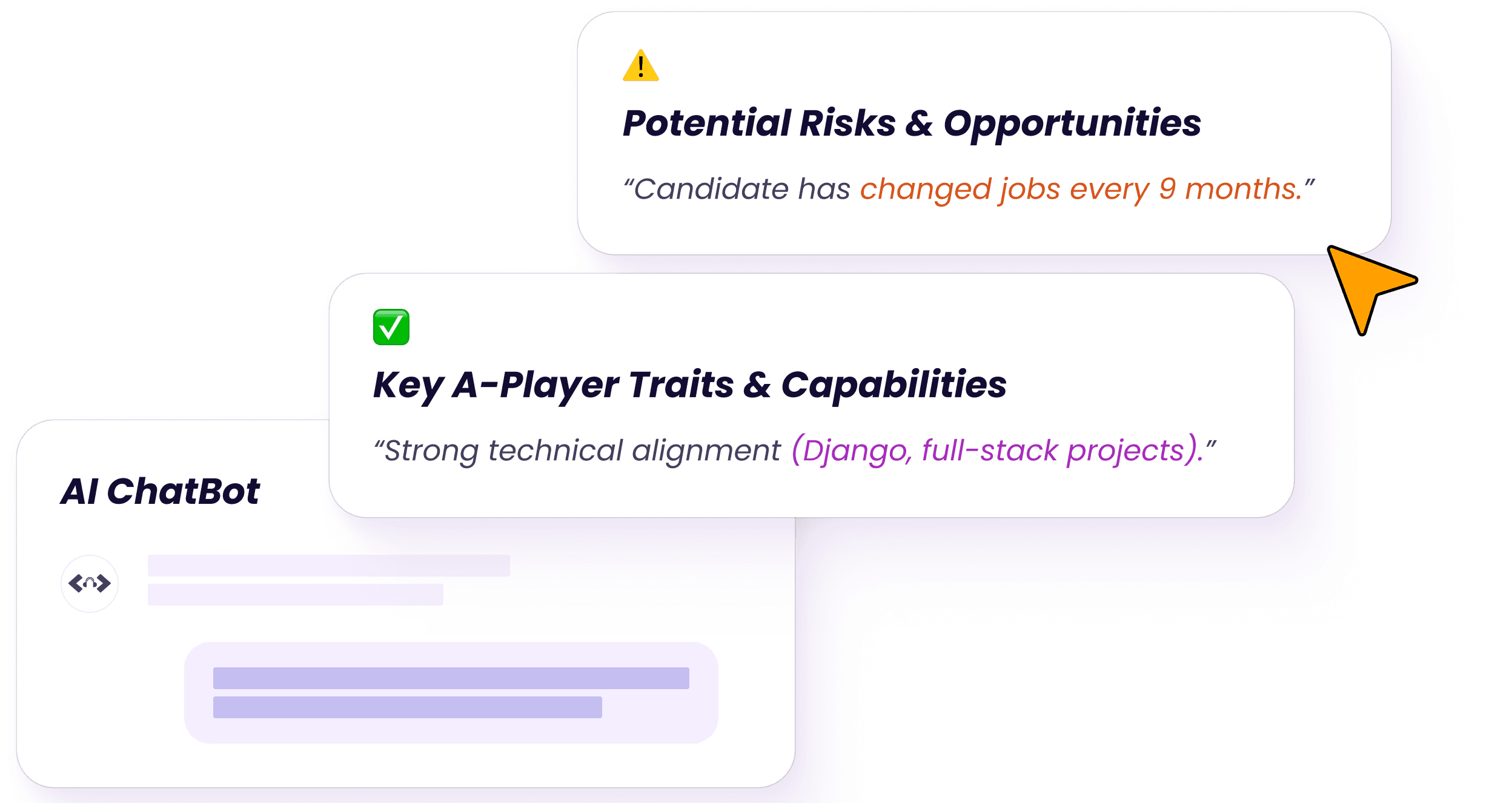
Let AgentR surface the patterns, risks, and opportunities, while you focus on the people.
Great hiring starts with great decisions.
Let AgentR surface the patterns, risks, and opportunities, while you focus on the people.
Great hiring starts with great decisions.
Let AgentR surface the patterns, risks, and opportunities, while you focus on the people.
2026 AgentR, All rights reserved