The ATS Created the Monster It Now Claims to Kill
The ATS Created the Monster It Now Claims to Kill
The ATS Created the Monster It Now Claims to Kill
Recruiting software didn't fail from bad intentions. The architecture was never built for the right question.
Recruiting software didn't fail from bad intentions. The architecture was never built for the right question.
Recruiting software didn't fail from bad intentions. The architecture was never built for the right question.

5 min read
5 min read
5 min read
Get weekly updates
Get weekly updates
Opinions
Opinions
Opinions
Published on:
Published on:
Published on:
Read Time:
Read Time:
Read Time:
Category:
Category:
Category:
Every vendor in the recruitment industry is telling you the same story right now.
Hiring is broken. Applications are out of control. Candidates are gaming the system with AI-generated resumes. You need smarter technology to find real talent in the noise.
It's a compelling pitch. There's just one detail missing from it.
The architecture selling you the solution is the same one that built the problem.
The Machine That Learned to Eat Itself
Go back to 2005. Job boards are multiplying. LinkedIn has just launched. And the companies building applicant tracking systems are racing to solve what looks like a simple logistics problem: too many candidates, not enough structure.
Their solution was logical. Build a pipeline. Parse every resume into fields. Let recruiters search by keyword. The filter was explicit: if your resume contains the right words — "project management, stakeholder alignment, cross-functional" — you advance. If it doesn't, you don't.
This wasn't presented as a perfect measure of job performance. It was presented as the only thing that worked at scale.
And it immediately created an incentive.
When a system filters on signals, rational people optimize for those signals. Resume coaches figured this out by 2008. By 2015, entire consulting practices existed to help candidates reverse-engineer ATS logic. The game was public. The rules were known. And the resume language shifting inside these platforms was visible to everyone — including the platforms themselves.
That's not a conspiracy. It's just what happens when you build a filter and tell the world exactly how it works.
The Second Decision That Made Everything Worse
If keyword parsing built the problem, Easy Apply turned it into a crisis.
LinkedIn's one-click application launched in 2011. Indeed followed. The logic was borrowed directly from e-commerce: reduce friction, increase conversion, improve the candidate experience. Fewer clicks means more completions.
What this actually eliminated was the only natural signal the hiring process had always relied on — effort.
Before Easy Apply, applying for a job required work. Research the company. Navigate the portal. Write something specific to the role. That friction wasn't a flaw. It was a weak but real proxy for genuine interest. A candidate willing to spend 45 minutes on a single application was telling you something.
One-click apply deleted that signal entirely.
When the cost of an action approaches zero, the volume of that action approaches maximum. Candidates who once applied to 10 jobs a month now apply to 150. Recruiters who once received 80 applications now receive 800. LinkedIn reported applications growing 45% year-on-year in 2024 alone — 11,000 applications submitted every single minute across the platform.
The firehose was opened by design. Nobody planned for what came out of it.
The Statistics That Always Gets Misread
Here's a number you'll find in almost every piece of hiring content: recruiters spend an average of 6–7 seconds reviewing a resume.
It's always presented the same way — as proof that humans are unreliable, that intuition fails, that you need algorithmic help. The implication is consistent: people are the problem.
What never gets mentioned is "why" the six-second review exists.
It exists because a recruiter managing 400 applications for a single role cannot spend more time per resume. The six-second scan isn't a cognitive failure. It's a triage response to a volume problem. And the volume problem was caused by keyword-optimized resumes and frictionless application design — both structural decisions that preceded the recruiter's behaviour entirely.
Presenting the symptom as the cause is how the wrong solutions keep getting built.
What Keyword Matching Actually Selected For?
Here's what two decades of keyword-based screening genuinely optimized for.
It finds candidates who understand how ATS systems work. Not candidates who are good at the job — candidates who are skilled at describing themselves in machine-readable language. These are different populations, and they overlap far less than the industry admits.
The result has a name: the Paper Tiger. Polished resume. Keyword-dense. Interview-ready. And frequently underperforming post-hire — not because they were dishonest, but because the system was measuring the wrong thing and they responded rationally to it.
Meanwhile, the filter quietly eliminates a different group. Career changers with genuine transferable skills but non-standard vocabulary. Practitioners from adjacent industries who use different words for the same function. Senior professionals who write plainly because they don't need to perform competence on paper. Candidates whose background doesn't map to the keyword taxonomy the parser expects.
These aren't edge cases. They're a substantial portion of the best candidates in any pool.
And you can never measure them. Nobody calls to say they were filtered out and would have been excellent. The harm is invisible, which makes it very easy to ignore.
Why AI Screening Doesn't Close the Gap?
The honest version of the current AI pitch is narrower than advertised.
Machine learning can read resumes faster. It can find non-obvious patterns. It can reduce certain categories of human bias. These are real capabilities.
But the fundamental problem hasn't changed. The system is still making inferences about job performance from a document that was constructed to pass the system. Better AI reading does not solve a document-gaming problem — especially when the documents are now being written by AI.
That's already happening. Candidates are using ChatGPT to tailor every application to every job description in under two minutes. Some platforms are now releasing tools to detect AI-written resumes.
Pause on that for a moment.
The industry is now building AI to detect the AI candidates use to game the AI that screens candidates who were already gaming simpler tools. Every layer adds complexity. None of it closes the gap between what the document says and what the person can actually do.
The Exit isn't a Better Filter
The hiring arms race has a specific structure: it escalates because both sides are optimizing for the same thing — the document.
The exit is not a smarter filter. It's different evidence.
Instead of asking "Does this resume contain the right signals?", ask "What does this person's actual career trajectory look like?, What did they do, in what sequence, in what context, with what outcomes?". Career patterns are structurally harder to fake. You cannot keyword-stuff your employment history. You cannot easy-apply your way to a coherent progression.
A career-changer who lacks the standard vocabulary but has genuine transferable capability becomes visible through trajectory, not text. A senior professional who writes plainly shows up through pattern, not keywords. The eight-month gap that caused an auto-rejection starts to look different when you see what the person was doing during it.
This also requires something the current paradigm structurally cannot offer: transparency about the methodology. The opacity of existing AI scoring is one of the central reasons recruiter trust in these tools has collapsed — Enhancv found that 56% of recruiters either ignore or don't have access to AI match scores in their own ATS. Publishing your evaluation logic — what patterns you look for, why, with what evidence — isn't vulnerability. It's the minimum condition for credibility.
A paradigm cannot fix itself from within. The keyword game has run its course. What replaces it needs to be built on different foundations entirely — ones that treat the resume as the beginning of understanding a candidate, not a checklist to be processed and discarded.
Hiring shouldn't reward tricks. It should reveal potential. Those are different goals — and right now, the infrastructure is only built for one of them.
AgentR replaces keyword-matching with career-signal evaluation — built to integrate with your existing stack. If your current process is generating more noise than signal, [see how it works](https://agentr.global).
Every vendor in the recruitment industry is telling you the same story right now.
Hiring is broken. Applications are out of control. Candidates are gaming the system with AI-generated resumes. You need smarter technology to find real talent in the noise.
It's a compelling pitch. There's just one detail missing from it.
The architecture selling you the solution is the same one that built the problem.
The Machine That Learned to Eat Itself
Go back to 2005. Job boards are multiplying. LinkedIn has just launched. And the companies building applicant tracking systems are racing to solve what looks like a simple logistics problem: too many candidates, not enough structure.
Their solution was logical. Build a pipeline. Parse every resume into fields. Let recruiters search by keyword. The filter was explicit: if your resume contains the right words — "project management, stakeholder alignment, cross-functional" — you advance. If it doesn't, you don't.
This wasn't presented as a perfect measure of job performance. It was presented as the only thing that worked at scale.
And it immediately created an incentive.
When a system filters on signals, rational people optimize for those signals. Resume coaches figured this out by 2008. By 2015, entire consulting practices existed to help candidates reverse-engineer ATS logic. The game was public. The rules were known. And the resume language shifting inside these platforms was visible to everyone — including the platforms themselves.
That's not a conspiracy. It's just what happens when you build a filter and tell the world exactly how it works.
The Second Decision That Made Everything Worse
If keyword parsing built the problem, Easy Apply turned it into a crisis.
LinkedIn's one-click application launched in 2011. Indeed followed. The logic was borrowed directly from e-commerce: reduce friction, increase conversion, improve the candidate experience. Fewer clicks means more completions.
What this actually eliminated was the only natural signal the hiring process had always relied on — effort.
Before Easy Apply, applying for a job required work. Research the company. Navigate the portal. Write something specific to the role. That friction wasn't a flaw. It was a weak but real proxy for genuine interest. A candidate willing to spend 45 minutes on a single application was telling you something.
One-click apply deleted that signal entirely.
When the cost of an action approaches zero, the volume of that action approaches maximum. Candidates who once applied to 10 jobs a month now apply to 150. Recruiters who once received 80 applications now receive 800. LinkedIn reported applications growing 45% year-on-year in 2024 alone — 11,000 applications submitted every single minute across the platform.
The firehose was opened by design. Nobody planned for what came out of it.
The Statistics That Always Gets Misread
Here's a number you'll find in almost every piece of hiring content: recruiters spend an average of 6–7 seconds reviewing a resume.
It's always presented the same way — as proof that humans are unreliable, that intuition fails, that you need algorithmic help. The implication is consistent: people are the problem.
What never gets mentioned is "why" the six-second review exists.
It exists because a recruiter managing 400 applications for a single role cannot spend more time per resume. The six-second scan isn't a cognitive failure. It's a triage response to a volume problem. And the volume problem was caused by keyword-optimized resumes and frictionless application design — both structural decisions that preceded the recruiter's behaviour entirely.
Presenting the symptom as the cause is how the wrong solutions keep getting built.
What Keyword Matching Actually Selected For?
Here's what two decades of keyword-based screening genuinely optimized for.
It finds candidates who understand how ATS systems work. Not candidates who are good at the job — candidates who are skilled at describing themselves in machine-readable language. These are different populations, and they overlap far less than the industry admits.
The result has a name: the Paper Tiger. Polished resume. Keyword-dense. Interview-ready. And frequently underperforming post-hire — not because they were dishonest, but because the system was measuring the wrong thing and they responded rationally to it.
Meanwhile, the filter quietly eliminates a different group. Career changers with genuine transferable skills but non-standard vocabulary. Practitioners from adjacent industries who use different words for the same function. Senior professionals who write plainly because they don't need to perform competence on paper. Candidates whose background doesn't map to the keyword taxonomy the parser expects.
These aren't edge cases. They're a substantial portion of the best candidates in any pool.
And you can never measure them. Nobody calls to say they were filtered out and would have been excellent. The harm is invisible, which makes it very easy to ignore.
Why AI Screening Doesn't Close the Gap?
The honest version of the current AI pitch is narrower than advertised.
Machine learning can read resumes faster. It can find non-obvious patterns. It can reduce certain categories of human bias. These are real capabilities.
But the fundamental problem hasn't changed. The system is still making inferences about job performance from a document that was constructed to pass the system. Better AI reading does not solve a document-gaming problem — especially when the documents are now being written by AI.
That's already happening. Candidates are using ChatGPT to tailor every application to every job description in under two minutes. Some platforms are now releasing tools to detect AI-written resumes.
Pause on that for a moment.
The industry is now building AI to detect the AI candidates use to game the AI that screens candidates who were already gaming simpler tools. Every layer adds complexity. None of it closes the gap between what the document says and what the person can actually do.
The Exit isn't a Better Filter
The hiring arms race has a specific structure: it escalates because both sides are optimizing for the same thing — the document.
The exit is not a smarter filter. It's different evidence.
Instead of asking "Does this resume contain the right signals?", ask "What does this person's actual career trajectory look like?, What did they do, in what sequence, in what context, with what outcomes?". Career patterns are structurally harder to fake. You cannot keyword-stuff your employment history. You cannot easy-apply your way to a coherent progression.
A career-changer who lacks the standard vocabulary but has genuine transferable capability becomes visible through trajectory, not text. A senior professional who writes plainly shows up through pattern, not keywords. The eight-month gap that caused an auto-rejection starts to look different when you see what the person was doing during it.
This also requires something the current paradigm structurally cannot offer: transparency about the methodology. The opacity of existing AI scoring is one of the central reasons recruiter trust in these tools has collapsed — Enhancv found that 56% of recruiters either ignore or don't have access to AI match scores in their own ATS. Publishing your evaluation logic — what patterns you look for, why, with what evidence — isn't vulnerability. It's the minimum condition for credibility.
A paradigm cannot fix itself from within. The keyword game has run its course. What replaces it needs to be built on different foundations entirely — ones that treat the resume as the beginning of understanding a candidate, not a checklist to be processed and discarded.
Hiring shouldn't reward tricks. It should reveal potential. Those are different goals — and right now, the infrastructure is only built for one of them.
AgentR replaces keyword-matching with career-signal evaluation — built to integrate with your existing stack. If your current process is generating more noise than signal, [see how it works](https://agentr.global).

Great hiring starts with great decisions.
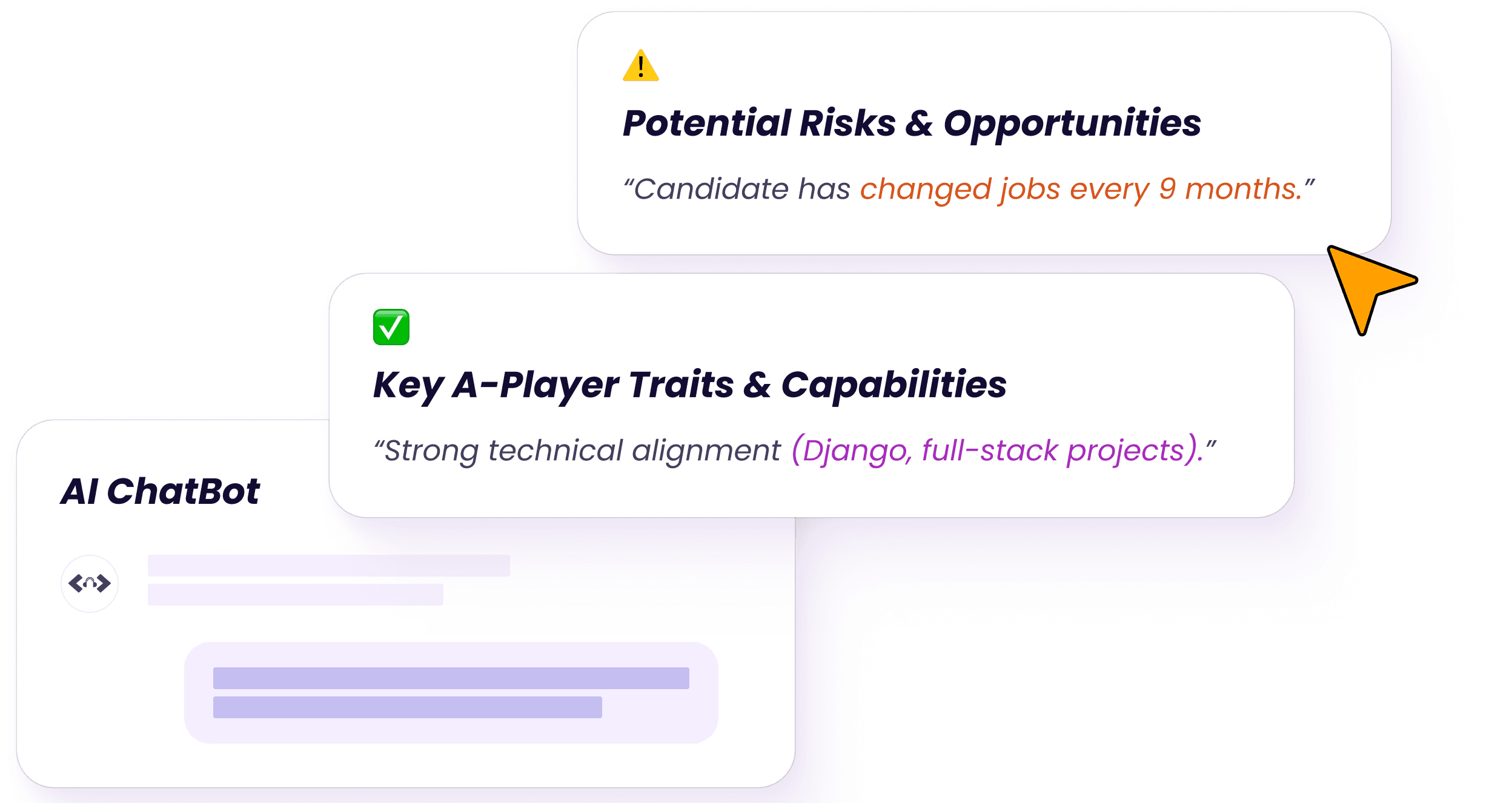
Let AgentR surface the patterns, risks, and opportunities, while you focus on the people.
Great hiring starts with great decisions.
Let AgentR surface the patterns, risks, and opportunities, while you focus on the people.
Great hiring starts with great decisions.
Let AgentR surface the patterns, risks, and opportunities, while you focus on the people.
2026 AgentR, All rights reserved