
On June 29, Brussels gave final approval to push the AI Act's high-risk obligations for recruiting AI from August 2026 to December 2027. Fewer than one in five companies had even finished classifying their hiring tools before the extension landed. The deadline moved. Nothing that was creating the exposure did.
For most of 2025 and the first half of 2026, talent acquisition and legal teams across Europe — and every US company hiring anyone based there — were quietly building toward a single date: August 2, 2026. That was when the EU AI Act's high-risk obligations were set to become enforceable for the systems that rank resumes, filter applications, and score candidates. It was the kind of deadline that gets a line item in a board deck and a Slack channel of its own.
On June 29, 2026, the Council of the EU gave its final green light to a "Digital Omnibus" package that pushes the deadline for stand-alone high-risk systems — recruiting tools included — to December 2, 2027. Parliament had already endorsed it on June 16. The law will take effect a few days after publication in the Official Journal, sixteen months later than everyone had been planning for.
The reaction in a lot of TA and HR organizations has been relief. That reaction is the mistake.
What actually changed in Brussels
The EU AI Act, passed in 2024, classifies AI systems that are used to place targeted job advertisements, filter or rank applications, or evaluate candidates as high-risk — the same regulatory tier as AI used in medical devices and critical infrastructure. Under the original timeline, the full set of obligations for those stand-alone, "Annex III" systems was due to bind on August 2, 2026. AI embedded in already-regulated products was on a separate, later track.
The Digital Omnibus doesn't remove the obligations. It reschedules them. Stand-alone high-risk systems — including every recruiting and candidate-screening tool in scope — now have until December 2, 2027. AI embedded in regulated products moves to August 2, 2028. The requirements themselves are essentially intact: conformity assessments, technical documentation, bias testing, human oversight, and mandatory log retention.
The stated rationale, echoed across the trade press covering the negotiation, was competitiveness — European companies weren't ready, American and Chinese AI vendors weren't waiting, and Brussels didn't want to be the jurisdiction that regulated its own industry into a corner while the rest of the world kept shipping. Whatever the merits of that argument at the macro level, it says something uncomfortable about the micro level: an extension granted because an entire regulated industry wasn't ready is not evidence that the industry has a plan. It's evidence that it didn't have one on the first deadline, either.
What was actually going to be required
It's worth being specific about what the sixteen-month reprieve postpones, because the list is not paperwork you generate in a weekend.
Article 26 of the Act puts the obligations on deployers — the companies actually using the tool, not just the vendors building it. That means naming specific, trained individuals with real authority to override or suspend the system's output, not a generic "human in the loop" checkbox. It means informing workers' representatives and affected candidates before the system is used, not after. It means retaining system logs for a minimum of six months. It means bias testing and technical documentation thorough enough to survive a conformity assessment, and for public-sector deployers, a fundamental rights impact assessment completed before deployment, not backfilled once regulators ask.
The penalties attached to getting this wrong are not symbolic. Non-compliance with high-risk obligations carries fines of up to €15 million or 3% of global annual turnover, whichever is higher. For a multinational employer, 3% of global turnover dwarfs whatever the compliance program would have cost to build properly the first time.
The readiness gap the extension didn't close
Here is the number that should worry anyone treating December 2027 as distant: fewer than one in five companies had completed even the risk classification step for their recruiting AI tools before this delay was granted, according to compliance-readiness research circulating from PwC's EU AI Act tracking and corroborated by Mercer's 2026 talent trends data. Classification — figuring out which of your tools are even in scope — is the easiest, cheapest, first step in the entire compliance chain. Bias testing and technical documentation, the two hardest and most time-consuming obligations, were reported as the least advanced areas of all.
That is the actual story behind the sixteen-month extension. It wasn't granted because companies were close and needed a little more runway to finish carefully. It was granted because most of the regulated population hadn't meaningfully started, and a hard deadline arriving on top of that reality would have produced either mass non-compliance or a compliance theater exercise completed in the final six weeks — audits performed to pass rather than to find anything, documentation written to exist rather than to explain.
Moving the date doesn't fix that dynamic. It just moves the same crunch to a later calendar page, for an organization that has now watched its own regulator confirm that deadlines in this space are negotiable. The rational response to "the deadline moved once" is not "we now have time." For a lot of TA leadership, it will be "we now have proof it might move again," which is precisely the belief that produces the same under-preparation, on a longer clock.
Meanwhile, the US didn't wait for Brussels
The relief many global employers are feeling misreads their actual exposure, because the EU AI Act was never the only clock running.
New York City's Local Law 144 has required independent bias audits and public disclosure for automated employment decision tools since July 2023 — three years in force already, with zero connection to anything happening in Brussels. Illinois's HB 3773 took effect January 1, 2026, requiring employers to notify candidates when AI is used in employment decisions and explicitly barring the use of zip code as a proxy for protected characteristics. Colorado, in a strange parallel to the EU's own move, delayed and narrowed its AI Act in May 2026 — pushing its effective date to January 2027 while stripping out the original risk-based duty-of-care framework in favor of narrower disclosure rules.
Read those three together and a pattern shows up that the EU extension obscures: the regulatory floor in the US didn't rise as fast as Brussels', but parts of it are already solid ground, enforced today, for any company hiring into New York or Illinois regardless of what happens to the European timeline. A global TA organization that exhales because Europe bought itself until December 2027 is still standing on US obligations that came due months or years ago. The EU delay changes the hardest deadline. It does not change the nearest one.
The deadline was never the actual problem
Strip away the calendar entirely and the underlying issue the Act is reaching for hasn't moved an inch: most recruiting AI in production today cannot explain, in terms a regulator, a candidate, or a plaintiff's attorney would accept, why it ranked one person above another. That is not a documentation gap that a compliance team fills in retroactively. It's an architecture gap.
A system built around an opaque match score has to have explainability bolted on afterward — a rationale generated after the fact to justify a ranking the model already produced through a process nobody can fully narrate. That is exactly the kind of after-the-fact paperwork that bias audits are designed to catch and that regulators are increasingly equipped to see through. A system built around an evaluated, human-legible trajectory — what someone actually did, in what order, with what outcome — produces its reasoning as a byproduct of how it works, not as a compliance artifact stapled on afterward. One of these approaches treats human oversight and transparency as the mission. The other treats them as a deadline to clear.
That distinction was true on August 2, 2026. It's still true on December 2, 2027. The date attached to it is the only thing that changed in Brussels last week.
The companies that won't scramble twice
Every regulatory extension creates two populations. One treats the extra sixteen months as license to deprioritize the work, on the reasonable-sounding logic that other things are more urgent right now and the deadline is, after all, not for a while yet. The other treats the same sixteen months as what it actually is: a rare, unearned second chance to build the underlying system correctly instead of retrofitting compliance onto whatever was already running.
The first group will be back in this exact position in the fourth quarter of 2027, except with less organizational patience for the topic, a compliance function that has cried wolf on its own urgency once already, and — if the EU's own precedent is any guide — a nonzero chance the deadline moves again and teaches everyone the same lesson twice. The second group will spend the next year building recruiting systems whose logs, oversight, and reasoning were never a bolt-on in the first place, and will find that the December 2027 deadline, whenever it actually lands, is not something they need to prepare for. It'll already be true.
The Digital Omnibus bought the hiring industry sixteen months. What it did with the previous eighteen is the only real predictor of what it does with these.
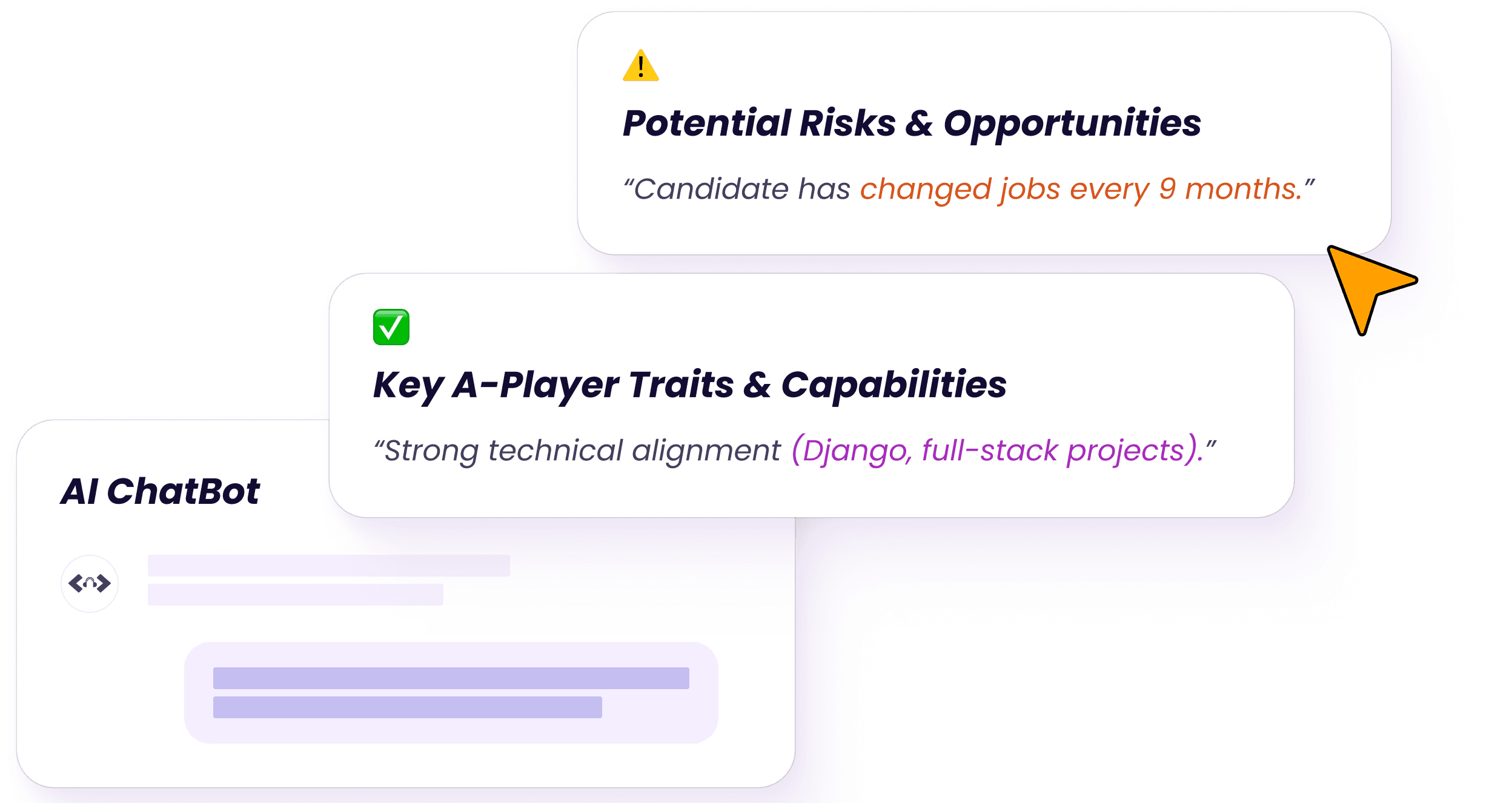
AgentR evaluates candidates on an explainable trajectory — the work actually done, in the order it happened, with outcomes a human reviewer can verify — rather than an opaque score generated by a black box. Human oversight and audit-ready reasoning aren't a compliance feature we added for a deadline; they're the only way the system was built to work. Whenever your regulatory clock actually runs out, you won't be retrofitting an explanation. Let's talk.

2026 AgentR, All rights reserved