The Post-Hire Data Gap Is Why Nobody Can Prove Their ATS Works
The Post-Hire Data Gap Is Why Nobody Can Prove Their ATS Works
The Post-Hire Data Gap Is Why Nobody Can Prove Their ATS Works
Recruiting owns the decision. HR owns the outcome. Nobody connects them.
Recruiting owns the decision. HR owns the outcome. Nobody connects them.
Recruiting owns the decision. HR owns the outcome. Nobody connects them.

5 min read
5 min read
5 min read
Get weekly updates
Get weekly updates
Research
Research
Research
Published on:
Published on:
Published on:
Read Time:
Read Time:
Read Time:
Category:
Category:
Category:
Here is a question that almost no recruiting function can answer:
Of the hires you made in the last two years, which ones came from which source, went through which screening process, scored what in your assessment, and are now performing how?
Not roughly. Not approximately. Precisely. With the ability to trace a specific hire from the moment they applied, through every stage of your process, to their current performance quartile.
If you can answer that question with confidence, your organisation is in an exceptional minority. Most cannot. Not because the data doesn’t exist, it does, in at least two separate systems, but because those systems don’t talk to each other, and nobody has made connecting them a priority.
This is the post-hire data gap. And it is the reason that, despite billions spent on recruiting technology over the past decade, almost nobody can demonstrate whether their hiring process actually works.
Two Systems, One Decision
The modern HR technology stack has a structural fault line running directly through the hiring decision.
On one side: the ATS and recruiting infrastructure. These systems own everything that happens before day one. Application data, screening scores, interview notes, assessment results, offer terms. Every interaction with every candidate is captured, time stamped, and stored.
On the other side: the HRIS and performance management infrastructure. These systems own everything that happens after day one. Compensation history, performance review scores, promotion records, engagement survey responses, exit interview data, tenure.
The two sides of this stack are built by different companies, purchased by different teams, owned by different functions, and integrated (if at all) for payroll and benefits administration. They are not integrated in a way that allows you to connect a pre-hire signal to a post-hire outcome.
Which means the recruiting function makes decisions that produce outcomes it cannot observe. And without observing outcomes, it cannot learn.
The Compound Cost of Not Learning
The damage from this data gap compounds over time in a way that’s easy to miss because it happens slowly.
A recruiter makes an assessment call: this candidate’s non-standard background represents genuine transferable skill. They push for the hire. The candidate joins, performs in the top quartile for three years, gets promoted twice.
The recruiter never finds out. Their instinct was right, but the confirmation that would have sharpened that instinct, made them more confident applying it in future, more able to articulate it to a sceptical hiring manager, never arrives. The insight that would have improved every subsequent hire they made is siloed in a system they can’t access.
Now multiply that by every recruiter, every hire, every organisation in the market. The aggregate amount of signal that exists about what predicts performance, right there in people’s own company data, that is never used to improve hiring decisions, is staggering.
The industry spends enormous resources buying better screening tools. It spends almost nothing connecting the output of those tools to the outcomes they’re supposed to produce.
Why Quality of Hire Remains Unmeasurable?
SHRM calls quality of hire the holy grail of talent acquisition metrics. LinkedIn’s research consistently finds it at the top of the list of what talent leaders say they want to improve. Only 25% of organisations feel confident they can measure it.
The reason isn’t that quality of hire is conceptually difficult to define. It’s that measuring it requires connecting pre-hire data to post-hire data, across a data gap that most organisations have never systematically closed.
Brandon Jeffs, a talent acquisition leader who spoke at LinkedIn Talent Connect 2025, argued that quality of hire should be retired as a concept entirely, because “no one knows how to operationalise it.”
That’s a reasonable response to a genuine frustration. But retiring the metric doesn’t solve the underlying problem. It just means the recruiting function continues operating without feedback, and continues being unable to demonstrate its impact in terms that the business cares about.
The alternative, the harder but more valuable path, is to close the gap.
What Closing the Gap Actually Requires?
There is no single technology solution that solves this problem. It requires deliberate integration work and, more importantly, deliberate organisational alignment between two functions that don’t naturally collaborate.
Step one: agree on what “quality” means. Quality of hire is not a universal metric. A great hire for a startup where speed and adaptability are everything is different from a great hire for a compliance function where accuracy and process discipline matter most. Before you can measure quality, you need a shared definition between recruiting and the business of what a successful hire looks like at 6, 12, and 24 months.
Step two: create a structured 90-day signal. The clearest early indicator of hire quality is whether the new employee is ramping as expected by the end of their first quarter. A 90-day assessment, even a simple manager survey, creates a feedback loop that is close enough to the hire to be actionable. Most organisations have some version of this. Most don’t connect the results back to the recruiting function that made the hire.
Step three: build a common identifier. The technical barrier to connecting pre-hire and post-hire data is often simply that the ATS and HRIS use different candidate identifiers. Establishing a common key, even manually, at the point of hire, is unglamorous work that makes everything else possible.
Step four: run the retrospective quarterly. For every cohort of hires from a given quarter, map their performance data at 6 and 12 months back to their pre-hire signals. Which sources produced the highest-performing cohort? Which screening criteria correlated with performance? Which interviewers’ assessments were predictive? This doesn’t require sophisticated analytics. It requires asking the question with data in hand.
Step five: give recruiters access to the output. This sounds obvious. It rarely happens. Recruiter compensation and evaluation are almost universally tied to speed and volume metrics. If recruiters are given performance feedback on their hires, and if that feedback informs how they’re evaluated, the incentive structure changes, and so does the behaviour.
The Argument for Investing in This Infrastructure
The financial case for closing the post-hire data gap is, in purely economic terms, stronger than the case for almost any other HR technology investment.
Top performers generate 2.5x more output than average performers in standard roles. The salary differential between them is rarely more than 20-30%. Which means the ROI on consistently hiring top quartile performers, rather than the median the current process produces, is enormous.
But you can’t consistently hire top quartile performers if you don’t know what’s in your top quartile, where they came from, and what in your process predicted that they would end up there.
The process improvement that would most improve hiring quality is not a better ATS. It’s not AI screening. It’s not more sophisticated assessment. It’s a feedback loop. It’s the ability to learn from what the hires you’ve already made have taught you about what actually predicts performance in your organisation.
That learning is sitting in your HRIS right now. Nobody is reading it.
The Transparency That Recruiting Needs
There is a second dimension to this gap that is worth naming.
The recruiting function is routinely asked to justify its existence, its tools, its processes, and its cost. These conversations happen in budget cycles, reorganisations, and every time a bad hire becomes visible enough to trigger a post-mortem.
The recruiting function that cannot demonstrate a connection between its process and business outcomes is always on the back foot in these conversations. It can describe its activities, time-to-hire, cost-per-hire, funnel conversion, but it cannot make the fundamental claim that its decisions produced better business results than a less rigorous process would have.
The recruiting function that can show: our process, specifically the structured trajectory evaluation we added in Q2, correlates with a 40% higher 12-month performance rating in this cohort versus the prior cohort, that function is not justifying its existence. It’s demonstrating its value. In terms the CFO understands.
The data to make that argument exists in most organisations. It’s just never been connected.
The post-hire data gap is not a technology problem. It’s an organisational problem that technology can solve, once the organisation decides it matters enough to solve.
It matters more than most recruiting teams realise. And it will matter more than that in five years, when the organisations that built feedback loops are compounding on better hiring decisions every quarter, and the ones that didn’t are still wondering why their ATS score doesn’t predict anything.
Here is a question that almost no recruiting function can answer:
Of the hires you made in the last two years, which ones came from which source, went through which screening process, scored what in your assessment, and are now performing how?
Not roughly. Not approximately. Precisely. With the ability to trace a specific hire from the moment they applied, through every stage of your process, to their current performance quartile.
If you can answer that question with confidence, your organisation is in an exceptional minority. Most cannot. Not because the data doesn’t exist, it does, in at least two separate systems, but because those systems don’t talk to each other, and nobody has made connecting them a priority.
This is the post-hire data gap. And it is the reason that, despite billions spent on recruiting technology over the past decade, almost nobody can demonstrate whether their hiring process actually works.
Two Systems, One Decision
The modern HR technology stack has a structural fault line running directly through the hiring decision.
On one side: the ATS and recruiting infrastructure. These systems own everything that happens before day one. Application data, screening scores, interview notes, assessment results, offer terms. Every interaction with every candidate is captured, time stamped, and stored.
On the other side: the HRIS and performance management infrastructure. These systems own everything that happens after day one. Compensation history, performance review scores, promotion records, engagement survey responses, exit interview data, tenure.
The two sides of this stack are built by different companies, purchased by different teams, owned by different functions, and integrated (if at all) for payroll and benefits administration. They are not integrated in a way that allows you to connect a pre-hire signal to a post-hire outcome.
Which means the recruiting function makes decisions that produce outcomes it cannot observe. And without observing outcomes, it cannot learn.
The Compound Cost of Not Learning
The damage from this data gap compounds over time in a way that’s easy to miss because it happens slowly.
A recruiter makes an assessment call: this candidate’s non-standard background represents genuine transferable skill. They push for the hire. The candidate joins, performs in the top quartile for three years, gets promoted twice.
The recruiter never finds out. Their instinct was right, but the confirmation that would have sharpened that instinct, made them more confident applying it in future, more able to articulate it to a sceptical hiring manager, never arrives. The insight that would have improved every subsequent hire they made is siloed in a system they can’t access.
Now multiply that by every recruiter, every hire, every organisation in the market. The aggregate amount of signal that exists about what predicts performance, right there in people’s own company data, that is never used to improve hiring decisions, is staggering.
The industry spends enormous resources buying better screening tools. It spends almost nothing connecting the output of those tools to the outcomes they’re supposed to produce.
Why Quality of Hire Remains Unmeasurable?
SHRM calls quality of hire the holy grail of talent acquisition metrics. LinkedIn’s research consistently finds it at the top of the list of what talent leaders say they want to improve. Only 25% of organisations feel confident they can measure it.
The reason isn’t that quality of hire is conceptually difficult to define. It’s that measuring it requires connecting pre-hire data to post-hire data, across a data gap that most organisations have never systematically closed.
Brandon Jeffs, a talent acquisition leader who spoke at LinkedIn Talent Connect 2025, argued that quality of hire should be retired as a concept entirely, because “no one knows how to operationalise it.”
That’s a reasonable response to a genuine frustration. But retiring the metric doesn’t solve the underlying problem. It just means the recruiting function continues operating without feedback, and continues being unable to demonstrate its impact in terms that the business cares about.
The alternative, the harder but more valuable path, is to close the gap.
What Closing the Gap Actually Requires?
There is no single technology solution that solves this problem. It requires deliberate integration work and, more importantly, deliberate organisational alignment between two functions that don’t naturally collaborate.
Step one: agree on what “quality” means. Quality of hire is not a universal metric. A great hire for a startup where speed and adaptability are everything is different from a great hire for a compliance function where accuracy and process discipline matter most. Before you can measure quality, you need a shared definition between recruiting and the business of what a successful hire looks like at 6, 12, and 24 months.
Step two: create a structured 90-day signal. The clearest early indicator of hire quality is whether the new employee is ramping as expected by the end of their first quarter. A 90-day assessment, even a simple manager survey, creates a feedback loop that is close enough to the hire to be actionable. Most organisations have some version of this. Most don’t connect the results back to the recruiting function that made the hire.
Step three: build a common identifier. The technical barrier to connecting pre-hire and post-hire data is often simply that the ATS and HRIS use different candidate identifiers. Establishing a common key, even manually, at the point of hire, is unglamorous work that makes everything else possible.
Step four: run the retrospective quarterly. For every cohort of hires from a given quarter, map their performance data at 6 and 12 months back to their pre-hire signals. Which sources produced the highest-performing cohort? Which screening criteria correlated with performance? Which interviewers’ assessments were predictive? This doesn’t require sophisticated analytics. It requires asking the question with data in hand.
Step five: give recruiters access to the output. This sounds obvious. It rarely happens. Recruiter compensation and evaluation are almost universally tied to speed and volume metrics. If recruiters are given performance feedback on their hires, and if that feedback informs how they’re evaluated, the incentive structure changes, and so does the behaviour.
The Argument for Investing in This Infrastructure
The financial case for closing the post-hire data gap is, in purely economic terms, stronger than the case for almost any other HR technology investment.
Top performers generate 2.5x more output than average performers in standard roles. The salary differential between them is rarely more than 20-30%. Which means the ROI on consistently hiring top quartile performers, rather than the median the current process produces, is enormous.
But you can’t consistently hire top quartile performers if you don’t know what’s in your top quartile, where they came from, and what in your process predicted that they would end up there.
The process improvement that would most improve hiring quality is not a better ATS. It’s not AI screening. It’s not more sophisticated assessment. It’s a feedback loop. It’s the ability to learn from what the hires you’ve already made have taught you about what actually predicts performance in your organisation.
That learning is sitting in your HRIS right now. Nobody is reading it.
The Transparency That Recruiting Needs
There is a second dimension to this gap that is worth naming.
The recruiting function is routinely asked to justify its existence, its tools, its processes, and its cost. These conversations happen in budget cycles, reorganisations, and every time a bad hire becomes visible enough to trigger a post-mortem.
The recruiting function that cannot demonstrate a connection between its process and business outcomes is always on the back foot in these conversations. It can describe its activities, time-to-hire, cost-per-hire, funnel conversion, but it cannot make the fundamental claim that its decisions produced better business results than a less rigorous process would have.
The recruiting function that can show: our process, specifically the structured trajectory evaluation we added in Q2, correlates with a 40% higher 12-month performance rating in this cohort versus the prior cohort, that function is not justifying its existence. It’s demonstrating its value. In terms the CFO understands.
The data to make that argument exists in most organisations. It’s just never been connected.
The post-hire data gap is not a technology problem. It’s an organisational problem that technology can solve, once the organisation decides it matters enough to solve.
It matters more than most recruiting teams realise. And it will matter more than that in five years, when the organisations that built feedback loops are compounding on better hiring decisions every quarter, and the ones that didn’t are still wondering why their ATS score doesn’t predict anything.

Great hiring starts with great decisions.
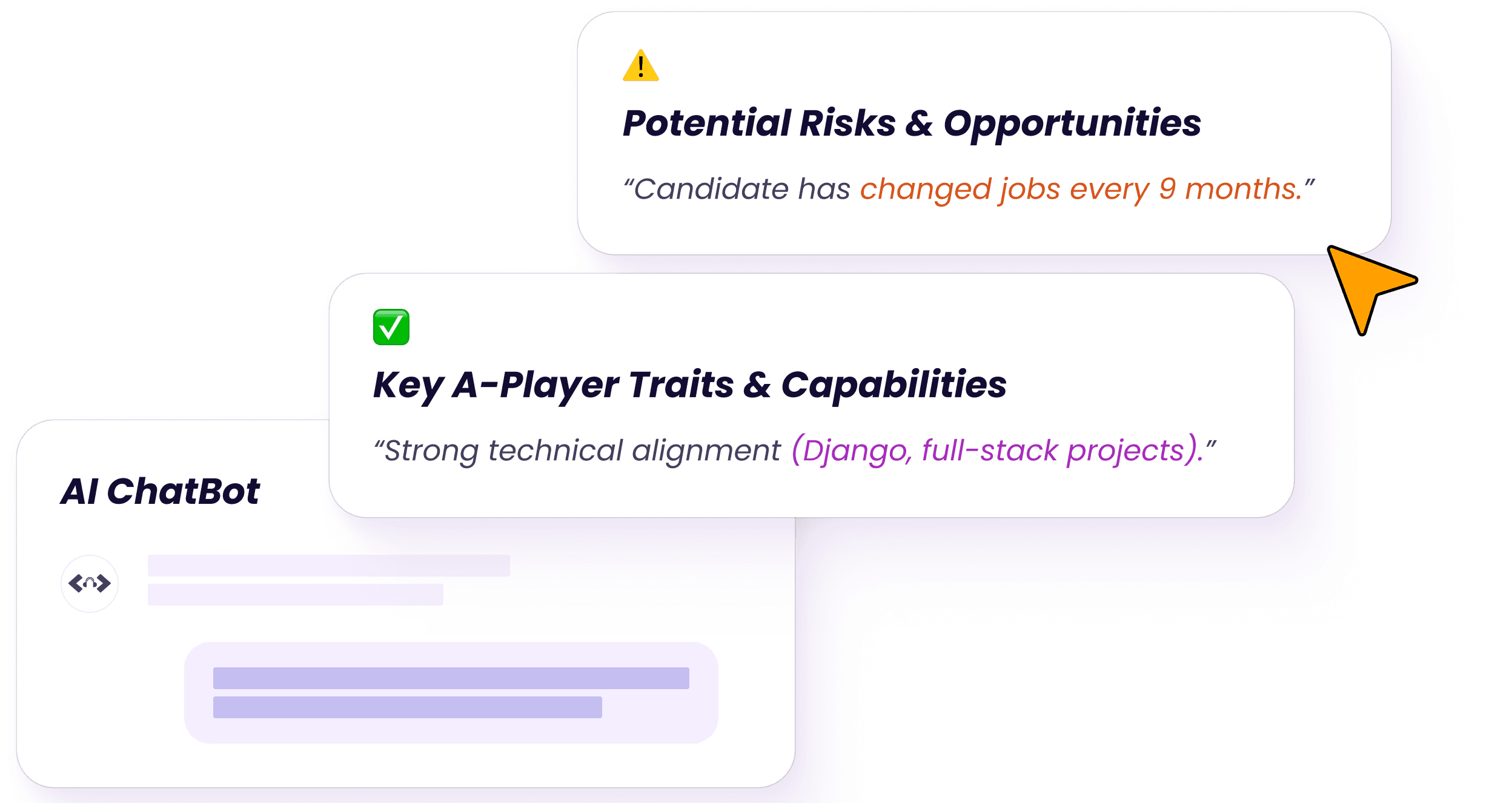
Let AgentR surface the patterns, risks, and opportunities, while you focus on the people.
Great hiring starts with great decisions.
Let AgentR surface the patterns, risks, and opportunities, while you focus on the people.
Great hiring starts with great decisions.
Let AgentR surface the patterns, risks, and opportunities, while you focus on the people.
2026 AgentR, All rights reserved